Why we stopped making technique shorts
Eighty-eight shorts, one honest look at the numbers, and a format change we did not want to make.
For a long time this channel made two kinds of video. One kind taught a technique: how to strike a ball with the outside of the foot, how to turn away from a marker, how to time a jump. The other kind put a whole team on the board and explained a system.
They felt like the same product. Same board, same drawing, same voice. The numbers say they are not the same product at all.
The number that decided it
Across everything published: 7 of 23 whole-team system clinics broke 20,000 plays. 1 of 36 individual-technique shorts did. Not a small edge. Roughly a seven-fold difference in the rate at which a video finds an audience, on the same channel, in the same style, in the same week.
7 of 23 system clinics broke 20,000 plays. 1 of 36 technique shorts did.
The temptation at that point is to explain it away, and there is always a way to. Different thumbnails, different weeks, the algorithm. But 36 attempts is not a sample you get to dismiss, and the one that did break through was not a technique short that worked, it was a technique short about a decision.
Why we think it happens
A technique is something you already know exists. You have seen the outside-of-the-foot pass a thousand times, and watching a diagram of it confirms rather than reveals. A system is a thing you have watched for years without being able to name. Seeing it drawn is the first time it holds still.
The best watch-through rate on the channel is 65%, on the underlap, and the underlap is the smallest system we have ever drawn: one full-back running inside his winger instead of around him. It is not big. It is a decision that forces another decision, and that is apparently the shape of thing people finish watching.
What changed downstream
Every video became a system, and the library on this site is built from the ones that already proved it. That is also why the pages here are structured as phases rather than as articles: the phase is the unit that worked on video, so it is the unit the page is built from.
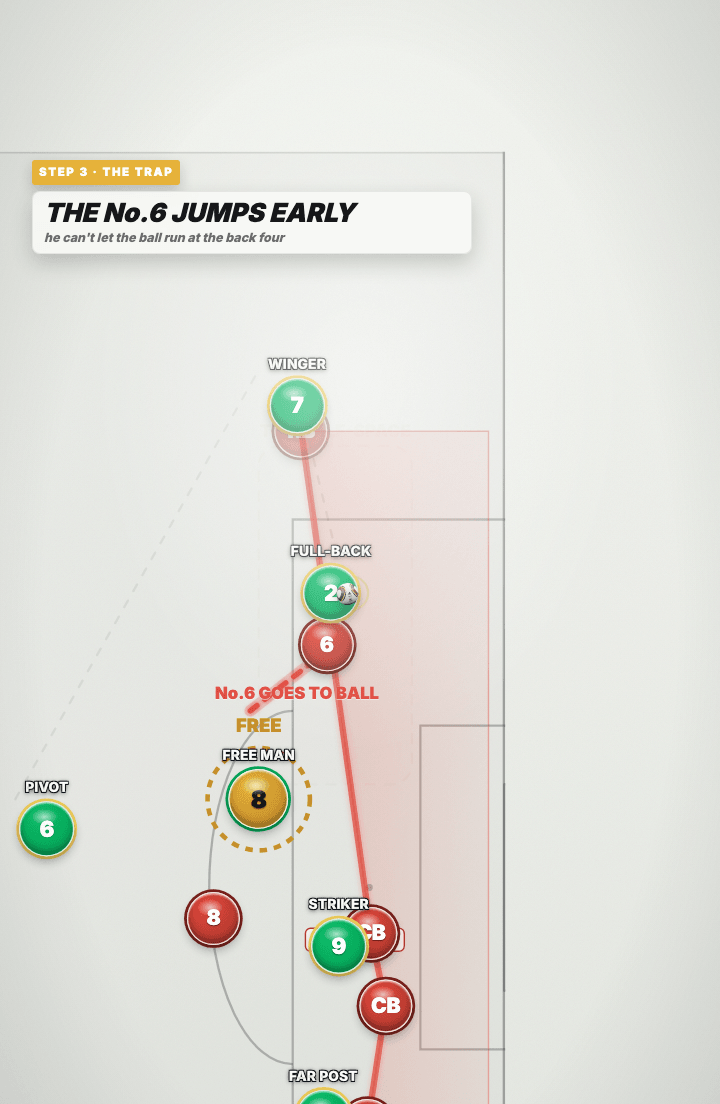
On the board Defending In A Back Four The one that has been watched the most 6 phases →It changed the shape of individual videos too. A system needs a state to change, so there is always a before and an after: a block that holds and then goes, a line that sits and then steps. A technique short has one state and a repetition, which is a demonstration rather than a story.
On the board The 4-4-2 Mid-Block A block that waits, then does not 6 phases →The part that is not about the numbers
One thing did not change and will not: every frame is drawn. There is not a single clip of broadcast footage in 88 shorts. That started as an ethical position about using other people’s pictures and turned out to be a practical one as well, since nothing here can be claimed by anybody.
It also means the board can show things a camera cannot. A camera films where the ball is. A diagram can hold the far side of the pitch on screen while the ball is nowhere near it, and the far side is usually where the system is.
The honest summary is that we made 36 of something before checking whether it worked. The library is what happened after we checked.
Drawn from
Every claim above is on one of these boards.
Nothing in this post teaches something the diagrams do not show. That is a rule, not a coincidence: the article is written from the systems, never the other way round.
The notebook
One system, explained, every week.
The diagram, the principle, and the detail most people miss. Unsubscribe in one click.
Read next
Narrow is not compact
Two words used as if they mean the same thing. One of them is a strength you build. The other is a weakness you can punish.
The extra man
Build-up is arithmetic before it is technique. Two ways to make three against two, and what the pressing team does about it.
One presses, three solve
Watch a back four for one phase and you see four defenders. Watch it for six and you see four jobs being handed down a line.