Defending · 6 phases
The 4-4-2 Mid-Block
A mid-block defends by making the middle of the pitch unavailable and the outside of it inviting. Two banks of four hold a gap of roughly fourteen metres between them, the strikers screen the opponent’s deepest midfielder, and the whole unit slides across as the ball moves. The pass down the touchline is the trigger: the moment it travels, the block stops waiting and presses.
- Phases
- 6
- Original
- 24s
- Plays
- 60,000
- Updated
- Aug 2026
Swipe to change phase
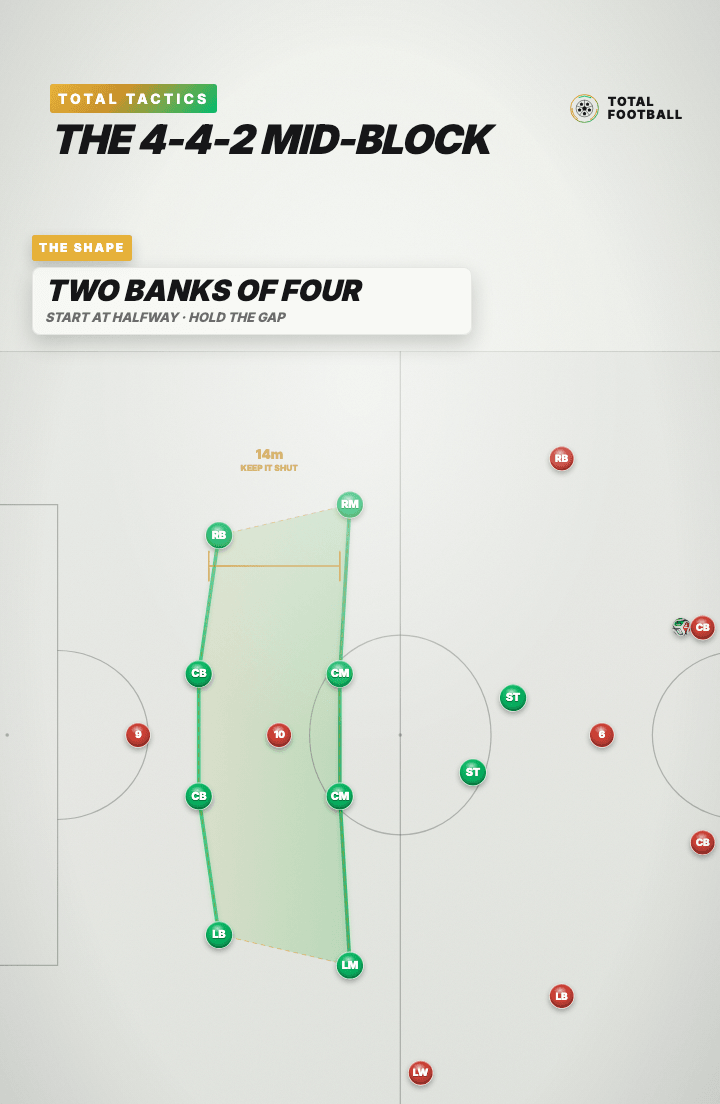
Phase 01 · The shape at halfway, with the gap between the lines measured.
Two banks of four
The defending team is in green, its own goal on the left, and the whole thing starts around the halfway line rather than deep. What matters is drawn on the board as a number: the band between the back four and the midfield four is about fourteen metres, and holding it is the entire discipline. Too wide and a midfielder can receive between the lines and turn. Too narrow and the ball simply goes over the top into the space behind. The two strikers stay high as a pair. Nobody in this picture is marking anybody; the block is arranged against the pitch, not against opponents, and that is what lets ten players cover the dangerous ground with eight.
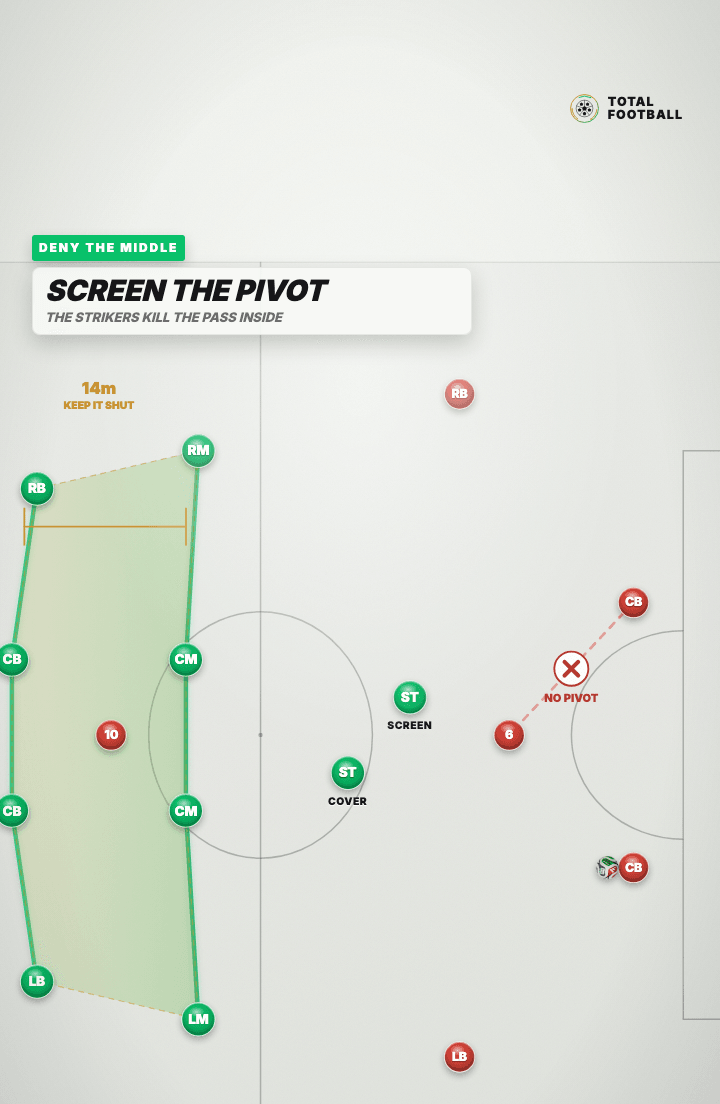
Phase 02 · The strikers screen the pivot, and every inside lane dies.
Deny the middle
The first job of the two strikers is not to chase centre-backs. It is to stand in the passing lane to the opponent’s deepest midfielder so that the one player who could turn and play forward never receives the ball at all. The board marks the result rather than the effort: no pivot, no pocket, no way through. This is the least glamorous idea in defending and the most valuable. The opposition still has the ball and can pass it sideways all day, but every route that would actually hurt is closed before it is attempted. A team that shuts the middle properly barely has to tackle.
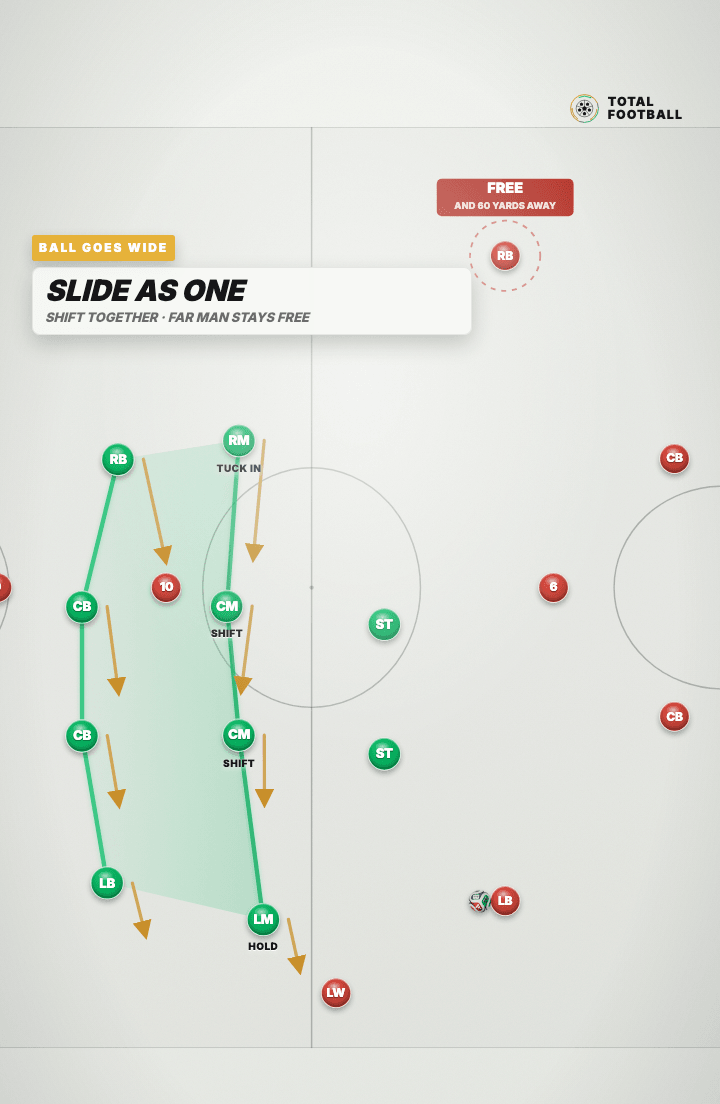
Phase 03 · The ball goes wide and the whole block shifts with it.
Slide as one
The ball is worked out to a full-back, and all ten players shift toward that side together. The near winger comes across, the far winger tucks all the way infield, and the block arrives on the ball side still holding its shape. It looks like the far side has been abandoned, and it has, deliberately. The furthest opponent is left completely free because a ball travelling all the way across the pitch takes long enough that the block can slide back before it arrives. You are conceding the pass that costs a second and a half in order to deny every pass that costs a tenth of one.
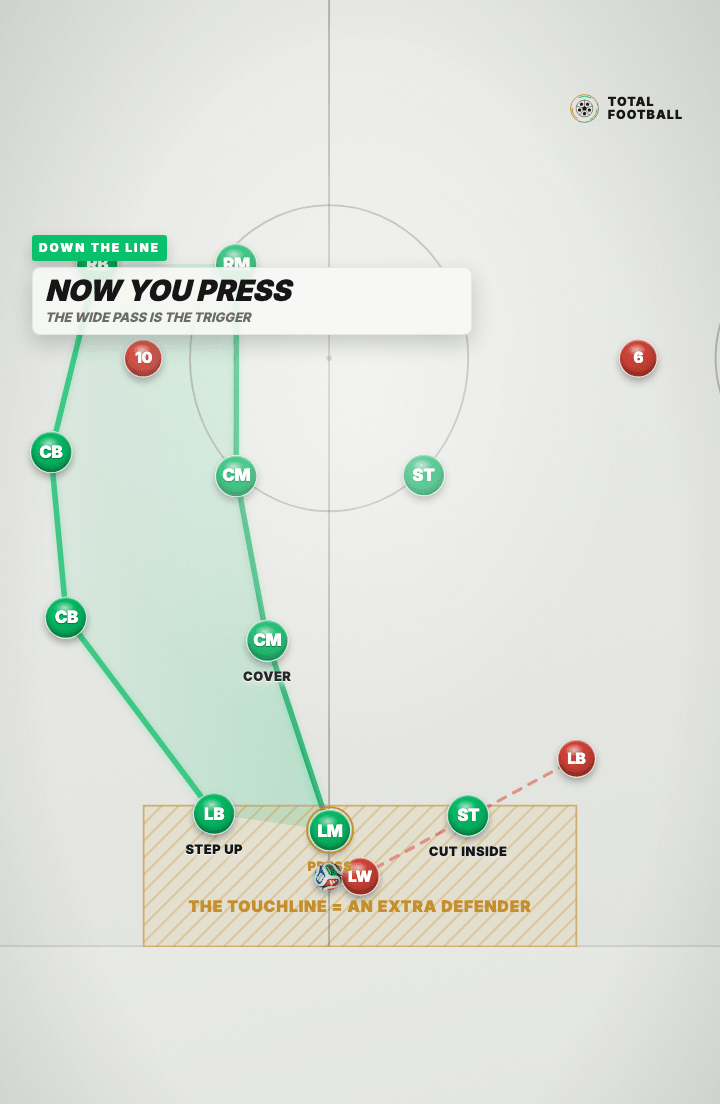
Phase 04 · The pass down the line is the signal: now the block presses.
The trigger
Everything so far has been patient. This is the moment it stops. The ball is played down the touchline, and because the receiver is facing his own goal with a white line at his shoulder, the whole unit launches at once: the near midfielder presses the ball, the midfielder inside him covers, the full-back steps up rather than dropping off, and the striker cuts back inside to kill the pass to the pivot. The board states why this pass and not another: the touchline is an extra defender. He has no half of the pitch to his left, no forward option, and the man behind him has already been screened.
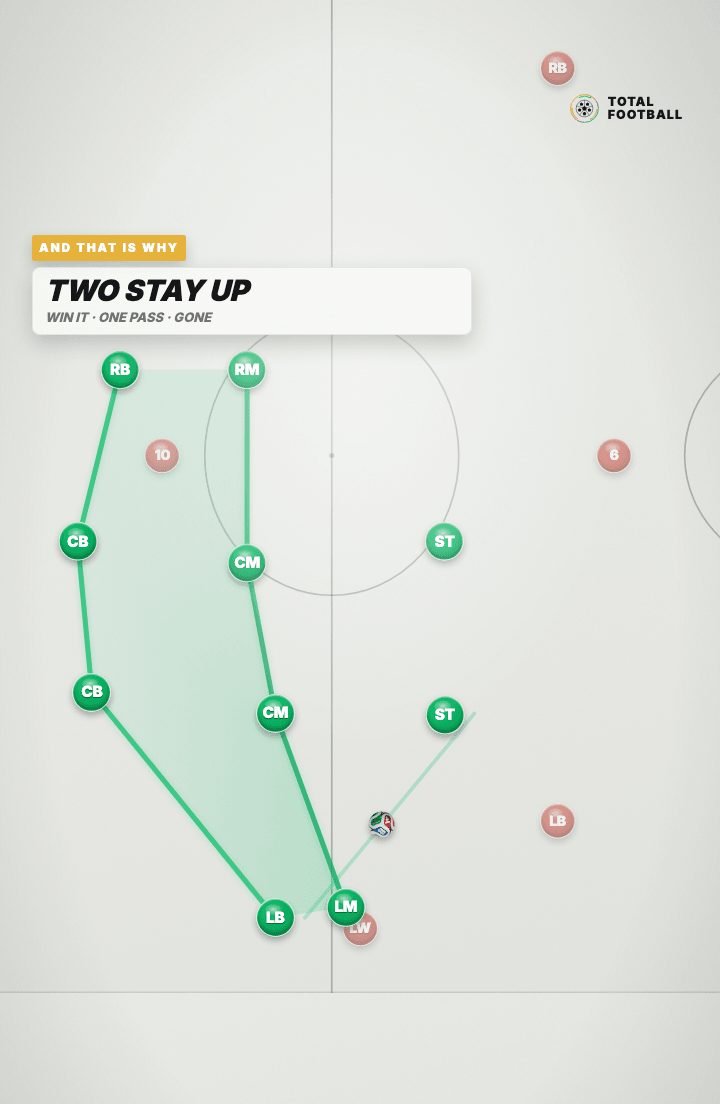
Phase 05 · The ball is won high, and the two who stayed up are the outlet.
Win it, and go
The trap closes and the ball is turned over near the opposition’s own third. This is where the two strikers who spent the whole sequence apparently doing nothing earn their place. They never dropped in to help defend, so at the instant of the turnover there are already two attackers ahead of the ball with the opposition’s defence facing the wrong way. A block that wins possession with all ten players behind the ball has won nothing except a goal kick to come. Keeping two high is what converts defending into attacking without a single extra sprint.
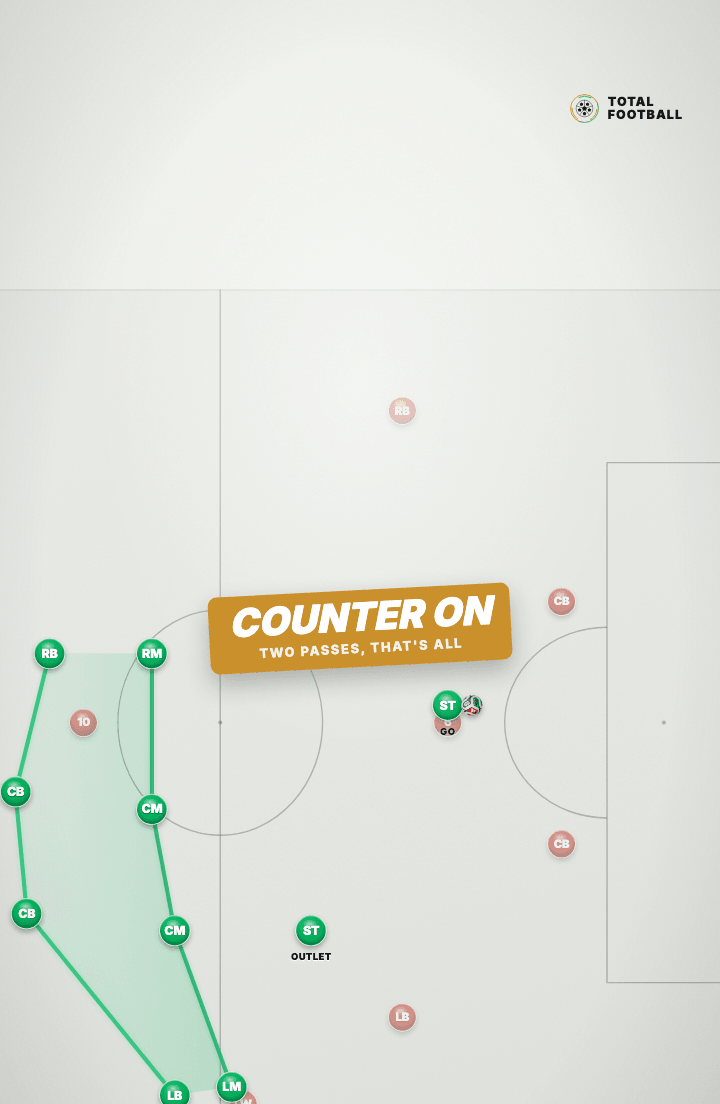
Phase 06 · The counter lands in exactly the space the press just vacated.
Two passes, that is all
The finish takes two passes. That is not a flourish, it is arithmetic: the opponents committed players forward to build, so the space behind their midfield is at its largest precisely when you take the ball off them. The counter runs straight into the middle of the pitch, the same middle the block spent the whole sequence refusing to let anyone use. That is the quiet symmetry of a mid-block. You make the centre worthless to them for ninety seconds so that it is worth everything to you for four.
The principles
- 01
The distance between your two banks is the whole system. Roughly fourteen metres, held.
- 02
You are not trying to win the ball in the middle. You are making the middle not worth trying.
- 03
The touchline is an extra defender: press wide, because he only has half a pitch to escape into.
How far apart should the two banks of four be?
About fourteen metres, and holding that distance is the whole system. It is close enough that nothing can be received between the lines and turned, and the moment it stretches, the block stops being a block and becomes eight players standing in two rows.
What are the two strikers doing in a mid-block?
Screening the opponent’s deepest midfielder rather than chasing centre-backs. Standing in front of the pivot kills every inside lane, so the ball has to travel around the block instead of through it. They are also the outlet: the two who stayed high are who the ball goes to the moment it is won.
When does a 4-4-2 mid-block actually press?
When the ball travels down the touchline. Up to that moment the block waits and slides across as one. The wide pass is the signal to stop waiting, because out there the touchline acts as an extra defender: the receiver has only half a pitch to escape into.
Next
Get the next one.
One system a week, drawn and explained the same way.