Defending · 6 phases
Defending In A Back Four
A back four defends as one connected unit, not as four individuals. One defender pressures the ball, the nearest covers behind him on a diagonal, and the far side tucks in to balance the shape. As the ball moves across the pitch those three jobs are handed down the line: the same four players, a different role each time.
- Phases
- 6
- Original
- 20s
- Plays
- 2,000,000
- Updated
- Aug 2026
Swipe to change phase
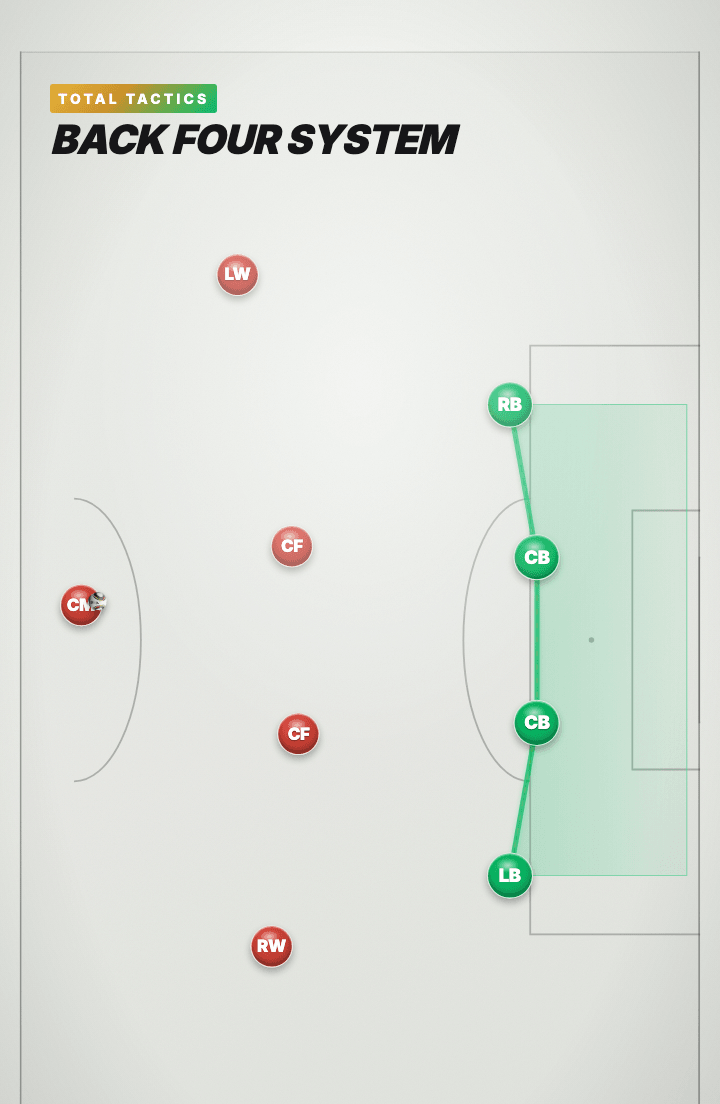
Phase 01 · Four defenders joined into one line, protecting the strip in front of goal.
The shape before anything happens
Start with the picture at rest. The goal being defended is on the right, the four defenders are the green counters, and the ball is with the deepest attacker on the far side of the pitch. Two things are worth noticing before anybody moves. The four are joined by a line, and that line is a shallow arc rather than a flat row: the two centre-backs sit fractionally deeper than the full-backs, which is what gives the shape depth. And the shaded band running from that line to the goal is what they are actually protecting: not the ball, not their opponents, but the strip of grass where goals get scored. Everything that follows is a consequence of those two facts.
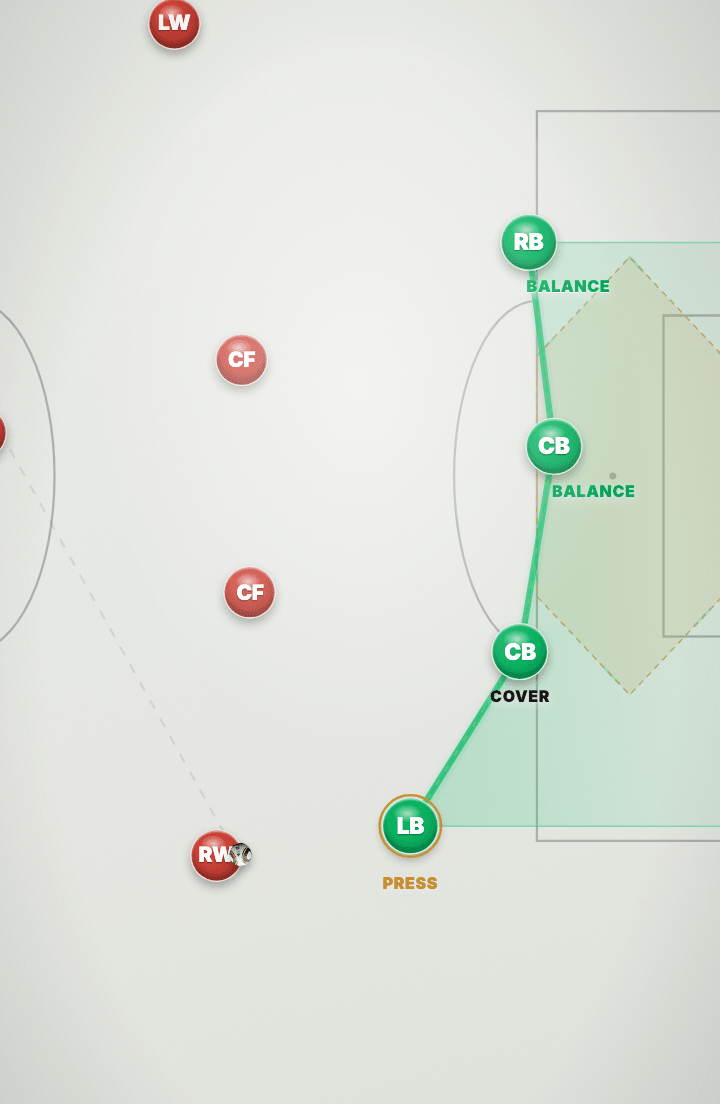
Phase 02 · The full-back presses; the centre-back covers behind him; the far side tucks in.
The ball goes wide: pressure, cover, balance
The ball is played out to the wide attacker and the three jobs appear at once, labelled on the board. The left-back steps out to PRESS, quickly at first, then slowing as he arrives so he is balanced and not beaten by the first touch, and angled to show the attacker away from goal rather than square to him. The centre-back beside him does not follow him out. He drops behind and inside on a diagonal, so that if the presser is beaten there is already a second defender in the path: COVER. The other two are marked BALANCE. They have left their direct opponents and tucked toward the middle. That is the part that looks wrong to beginners, two defenders apparently marking nobody, and it is the reason the shape holds.
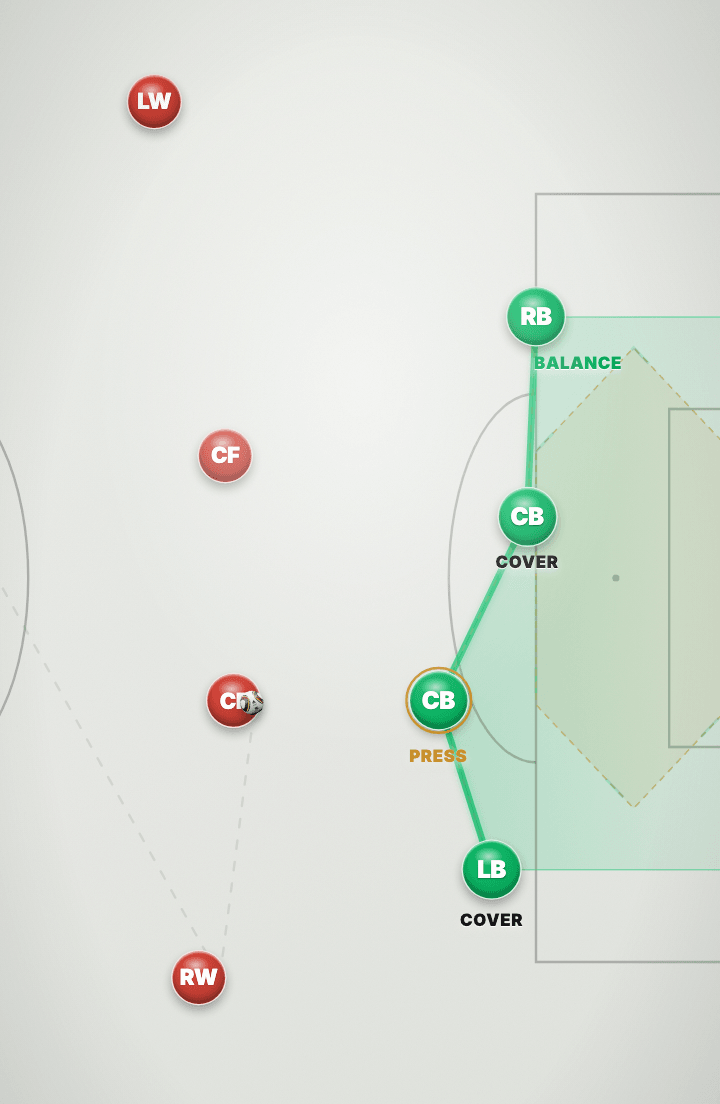
Phase 03 · A centre-back presses, and now he has cover on both sides of him.
The ball comes inside: the jobs hand over
The attacker plays the ball infield and every job changes owner without a word being said. The centre-back nearest the ball steps forward to PRESS, meeting the striker before the ball is settled, because a striker allowed to turn here is the entire problem. Look at what happens behind him: there are now two COVER labels, one above and one below. Because the presser is in the middle of the line rather than at its end, he can be beaten on either side, so both neighbours, the other centre-back and the left-back who was pressing a moment ago, drop in to protect a side each. That leaves exactly one man on BALANCE, the right-back, furthest from the ball. Nobody swapped positions. The ball moved, and the responsibilities moved with it.
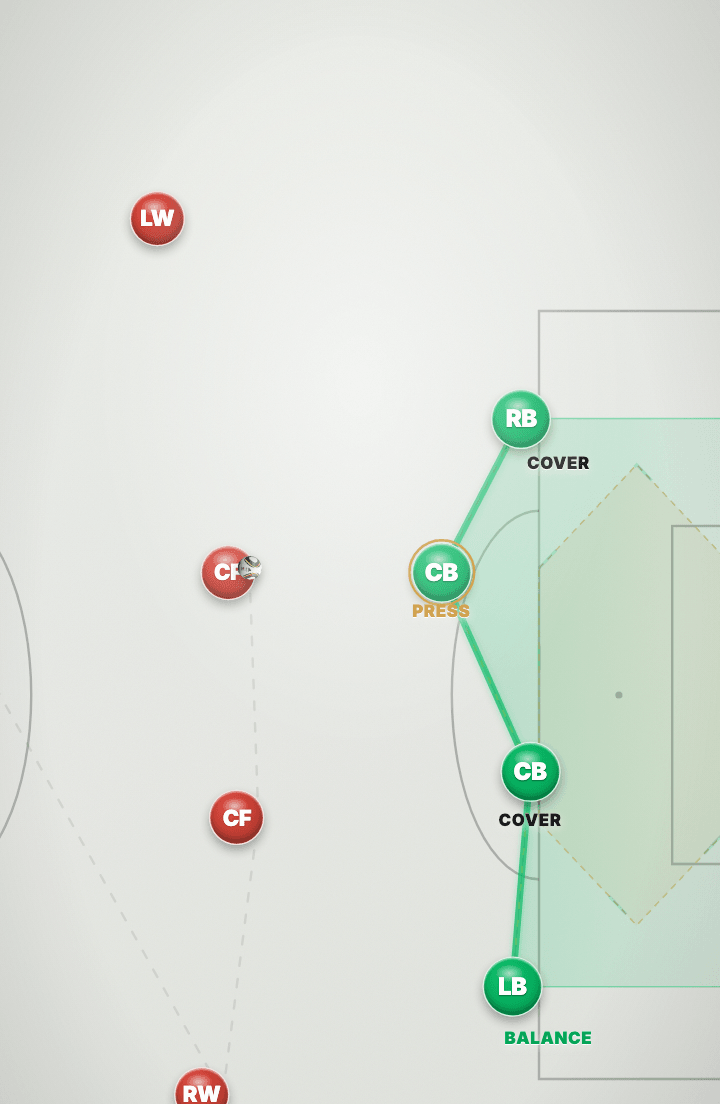
Phase 04 · The ball climbs to the second striker; the jobs walk one seat up the line.
The line slides, and no gap opens
The ball is worked to the other central attacker, higher up the pitch, and the whole line slides with it. The pressing job moves up one: a centre-back still presses, but now it is the ball-side one, and the labels behind him have rotated too: the right-back has become COVER, and the left-back, now furthest from the ball, is the lone BALANCE. The thing worth staring at is the connecting line itself. It has moved several metres up the pitch and changed shape slightly, but the distances between the four have not opened. That is the whole discipline. A line that slides together keeps every gap too small to pass into; a line where one man reacts late puts a door in the middle of the defence.
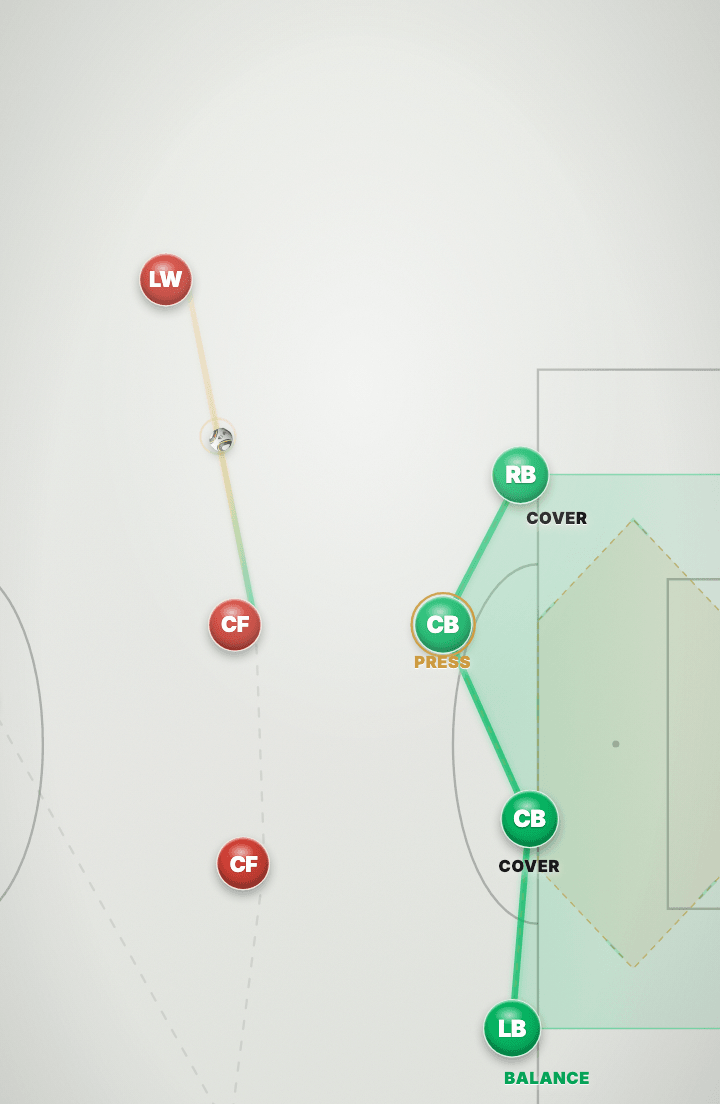
Phase 05 · The ball travels across; the whole line slides as one.
The switch: the moment it is decided
The ball is released to the far flank and caught here in mid-flight, still travelling. This is the phase that separates a back four from four defenders: the line is already moving. The labels have not caught up yet: a centre-back is still shown pressing the man who has just released it, but the shape underneath is sliding toward where the ball is going, not toward where it is. That head start is the entire margin. A ball crossing the pitch takes something over a second; the defender who has to meet it only has to travel ten or twelve metres, and he can only make that in time if he set off while it was in the air. The right-back, who spent the earlier phases tucked in with no direct opponent, is the man about to receive the pressing job.
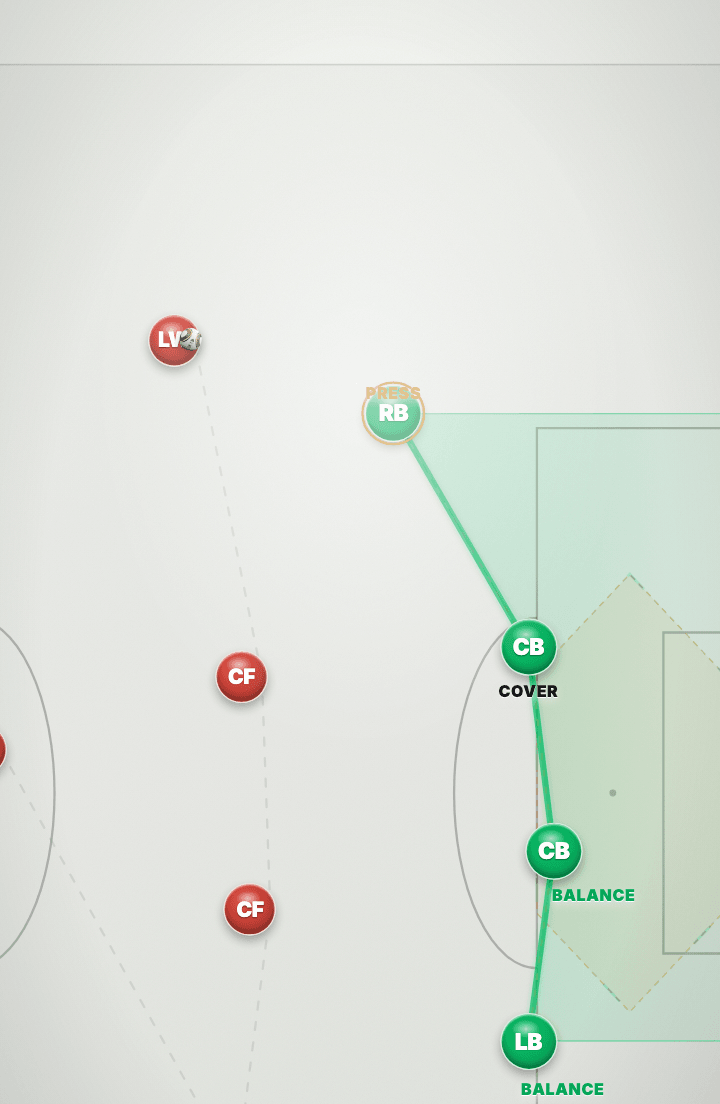
Phase 06 · The roles hand over again and the picture is a mirror of phase two.
Same shape, other side
The ball arrives and the picture is phase two, reflected. The right-back, the spare man who spent the whole sequence marking nobody, is now the one labelled PRESS. The centre-back inside him is COVER. The remaining centre-back and the left-back, who did the pressing and covering at the start, are now the two on BALANCE. Compare this frame with phase two and the only difference is which end of the line holds which job. That is the whole system. A back four is not four marking assignments; it is three jobs and a rule for who holds them, and the rule is always the position of the ball. Get that right and four players cover the full width of the pitch without any of them running more than a dozen metres.
The principles
- 01
Exactly one defender presses the ball. The other three are solving what happens after the pass.
- 02
The presser always has cover behind him, and two neighbours if he is in the middle of the line.
- 03
The far-side full-back marks nobody on purpose. His job is the switch, not his winger.
Is a back four zonal or man-marking?
The back four on this board is zonal. The four defend space as one connected unit and hand three jobs down the line (pressure, cover, balance) as the ball moves across, rather than each defender tracking a man wherever he goes. The same four players take a different role in every phase.
How many defenders should go to the ball?
Exactly one, at any moment. The presser always has cover behind him on a diagonal, and neighbours on both sides when he is in the middle of the line. The other three are not watching the ball at all; they are already solving what happens after the pass.
What is the far-side full-back supposed to be doing?
Marking nobody, on purpose. He leaves his own winger and tucks in to balance the shape, because his job is the switch across the pitch rather than the man in front of him. If he stays wide with his winger, the hole he leaves in the middle is worth far more than the player he covered.
Next
Get the next one.
One system a week, drawn and explained the same way.