Pressing · 6 phases
The Pressing Trap
You do not press constantly; you pick the moment and manufacture it. Shut the middle and leave one door open out to the touchline. When the ball travels through that door, the whole team launches at once, four players collapse on the receiver, and the sideline does the rest of the marking. The ball is won twenty yards from their goal.
- Phases
- 6
- Original
- 31s
- Updated
- Aug 2026
Swipe to change phase
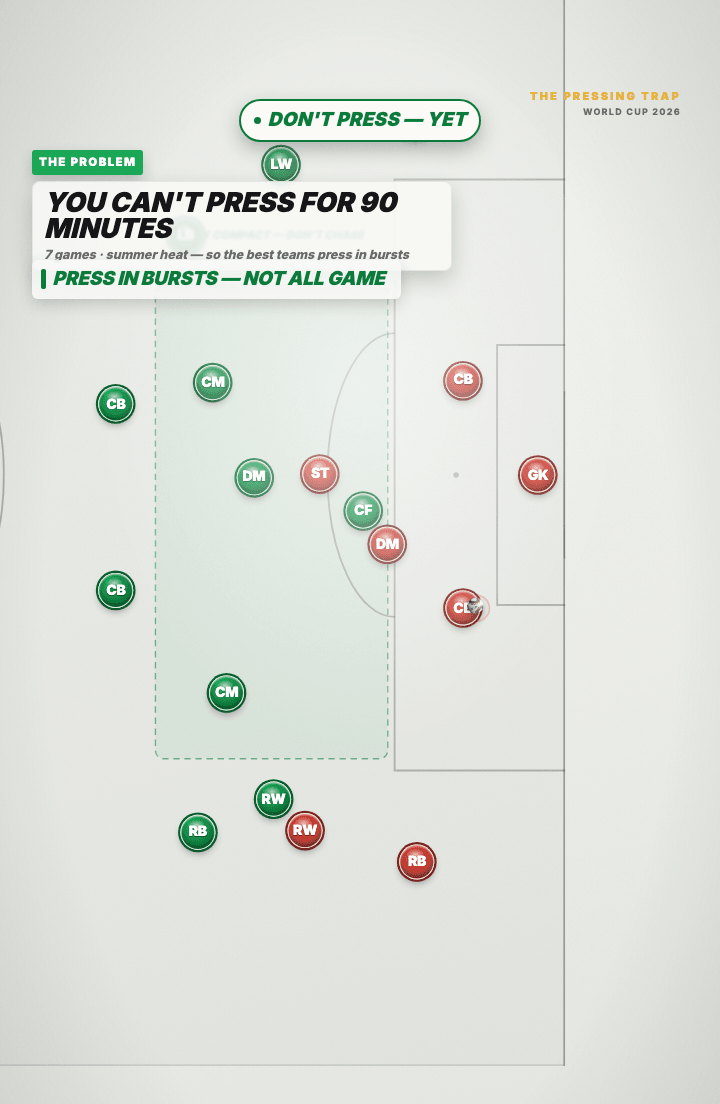
Phase 01 · The honest starting point, so pick your moment.
You cannot press for ninety minutes
The high press is sold as an attitude, which is why so many teams fail at it. Physically it is not available for a whole match, let alone seven matches in a summer tournament, and a press that runs out of legs on seventy minutes has spent the game creating the gaps it was supposed to close. The alternative is not to press less hard. It is to press in bursts that you choose in advance, from a stable shape, at a moment when the odds are good. Everything that follows is about manufacturing that moment rather than waiting for it.
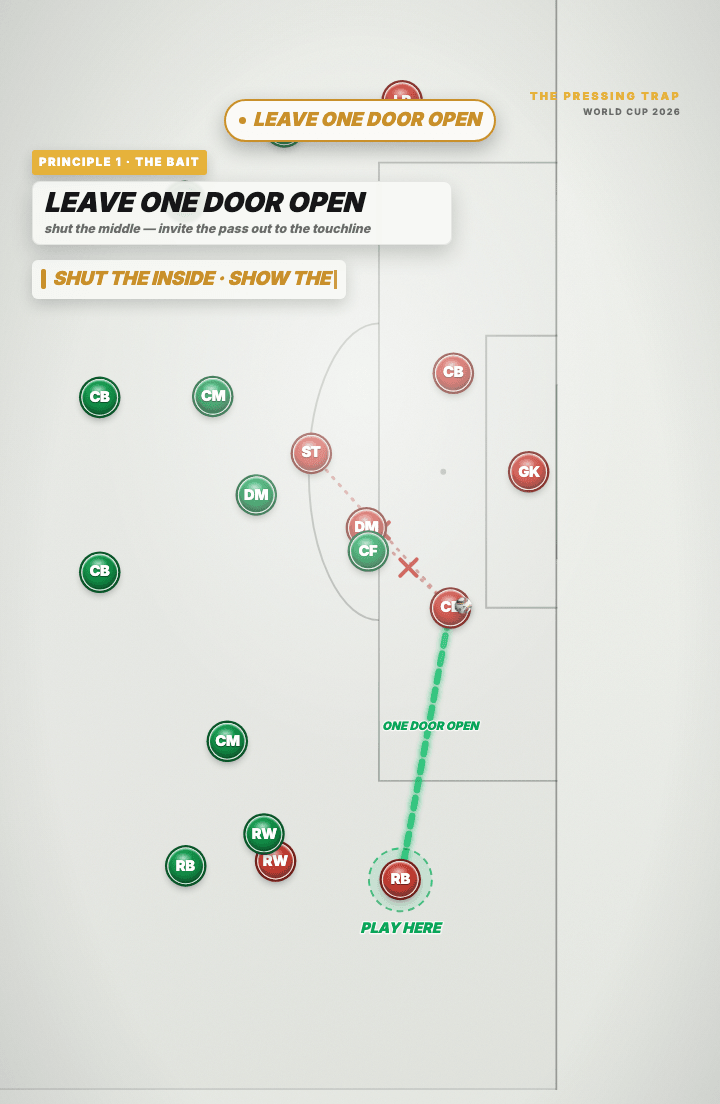
Phase 02 · Shut the inside, show the line, leave one door open.
The bait
A trap needs bait, and here the bait is a pass that looks safe. The central lanes are closed, the angles inside are covered, and the only available ball is the one out toward the touchline. From the point of view of the player on the ball this reads as an escape: nobody is within five metres of the receiver, and the pass is easy. That is exactly the impression you want. The board makes the intent explicit: shut the inside, show the line. You are not hoping he plays wide. You have arranged the picture so that it is the only sensible thing to do.
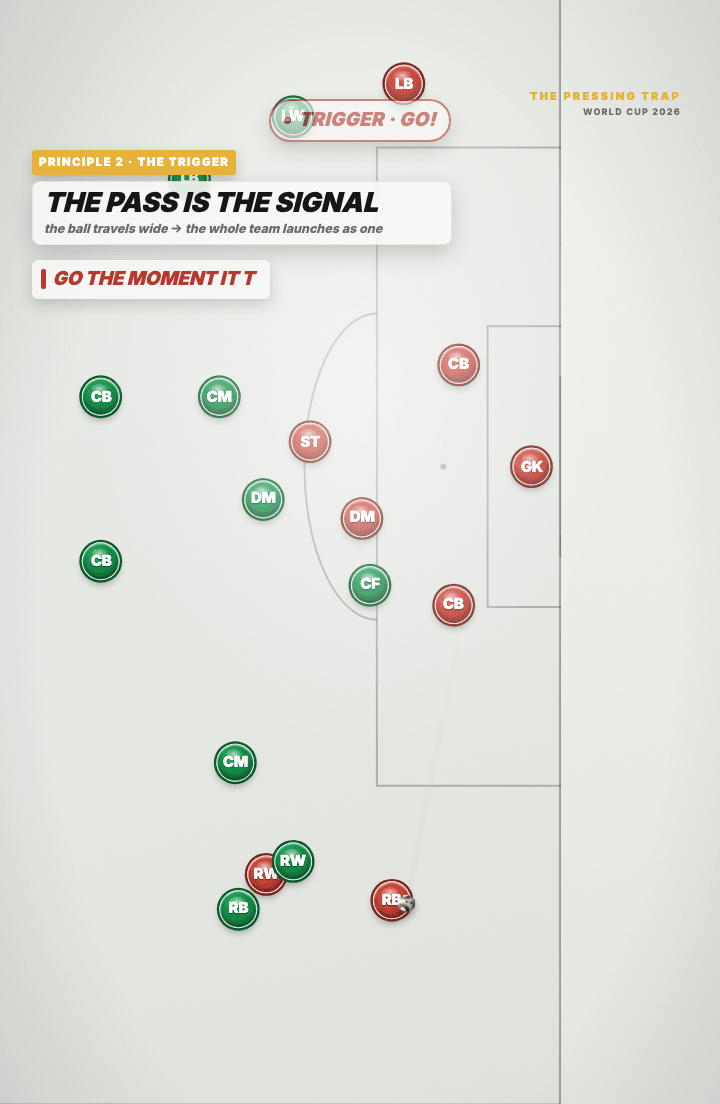
Phase 03 · The pass is the signal: go the moment it travels.
The trigger
The trigger is not the receiver taking a touch, and it is not a shout. It is the ball leaving the passer’s foot. A ball in flight cannot be recalled, so the entire defensive unit gets a free head start of roughly a second, the time it takes the pass to arrive. Pressing a player who already has the ball under control is a duel you might lose. Arriving as the ball does is not a duel at all. This single rule is the difference between a press that looks frantic and one that looks coordinated, and it is the reason the whole team can move at the same instant without anyone calling it.
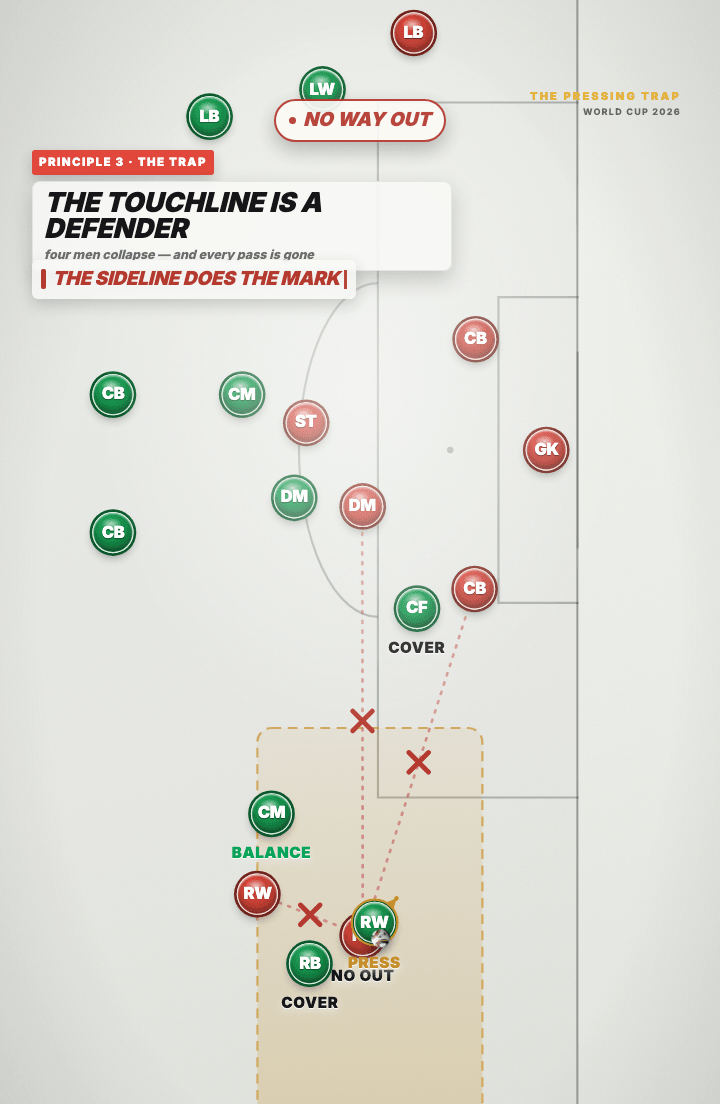
Phase 04 · Four collapse on him, and the sideline does the marking.
The trap
Four players arrive at once and each has a different job: one on the ball, one cutting the pass back inside, one on the man ahead down the line, one covering the ball over the top. What makes this affordable is the touchline. A player in the middle of the pitch has options in every direction and would need six defenders to surround; a player on the line has a white stripe doing the work of two of them, so four is enough. The board puts it plainly: the sideline does the marking. Everything the receiver can legally do is now covered by a body or by the edge of the pitch.
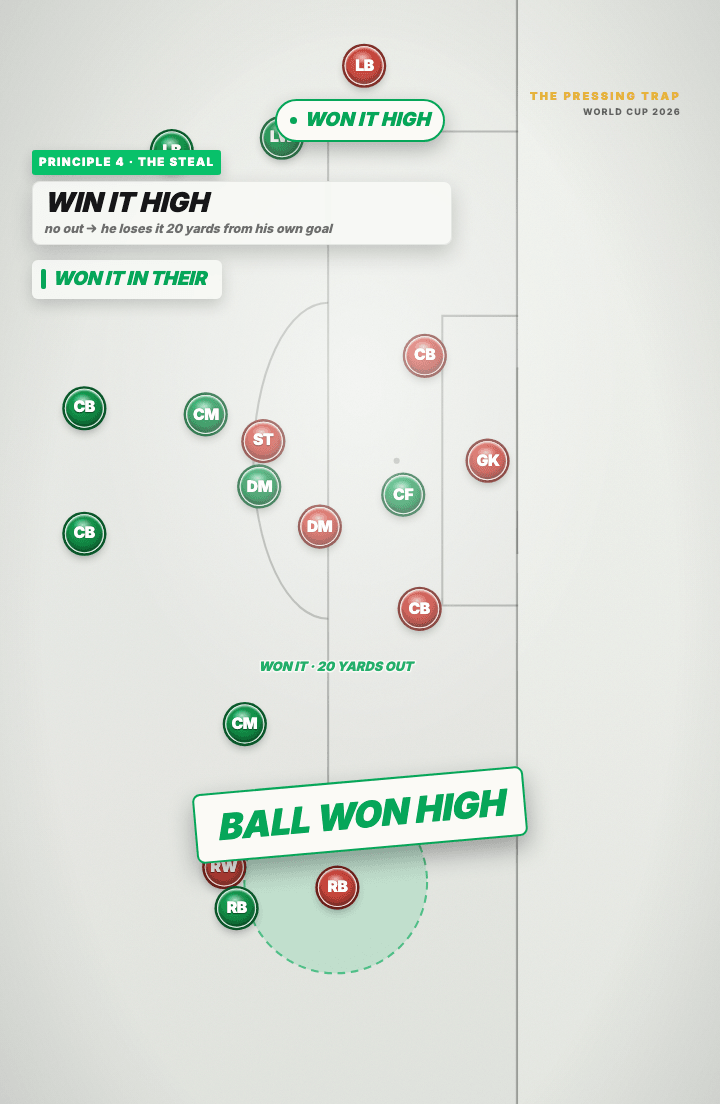
Phase 05 · No way out, and he loses it twenty yards from his own goal.
The steal
With no pass available and no space to carry into, the ball is lost. Where it is lost is the entire point. A turnover in your own half gives you possession against a set defence; a turnover here happens with the opposition’s players committed upfield, their defenders isolated, and their goalkeeper the only organised thing between the ball and the net. Winning the ball twenty yards from the opponent’s goal is worth more than any pass you could have made from your own half, and it was produced by five seconds of coordinated running rather than ninety minutes of it.
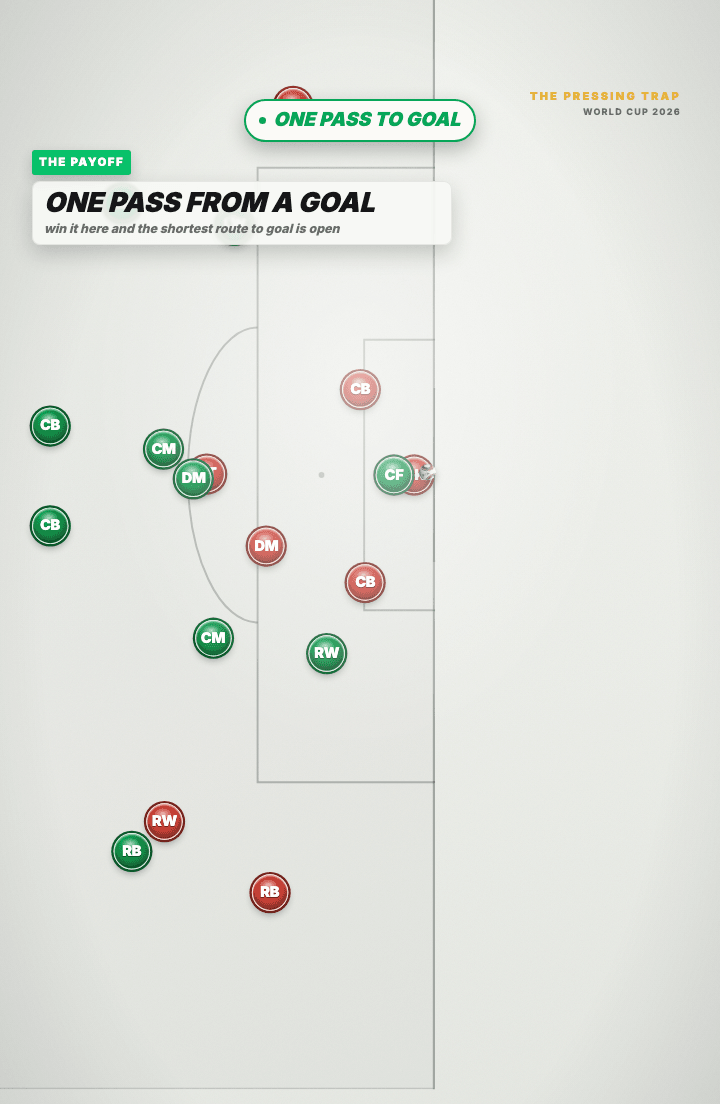
Phase 06 · Win it there and the shortest route to goal is already open.
One pass from a goal
The finish needs one pass. That is the return the whole method is built to collect: the reason for choosing the moment, baiting the door, triggering on the flight and accepting that you will spend the other eighty-five minutes in a block. A press is not a style, it is a transaction: you spend a burst of coordinated energy and you buy possession in the one area of the pitch where possession is nearly a chance. Spend it everywhere and you will be too tired to collect. Spend it here and two touches finish the move.
The principles
- 01
Nobody can press for ninety minutes. Choose the moment instead of chasing every ball.
- 02
A trap needs bait: leave exactly one pass available, and make it the one you want.
- 03
Press wide, not central. The touchline removes half of the receiver’s options for free.
Can a team press for ninety minutes?
No, and this system starts by admitting it. Nobody presses for ninety minutes; teams that try are walking by the hour mark and the shape they abandoned is the one they concede through. You choose the moment instead, and manufacture it.
What is the bait in a pressing trap?
One pass, left available on purpose. The inside is shut and exactly one door is open, the ball out to the touchline, so the pass you want played is the only sensible one on offer. The moment it travels, that is the trigger.
Why spring the trap wide rather than centrally?
Because the sideline marks for free. A player pressed in the middle can turn either way; pressed near the touchline, half his options are gone before anyone arrives. Four players collapse on him, the line covers the rest, and the ball is won twenty yards from his own goal.
Next
Get the next one.
One system a week, drawn and explained the same way.