Pressing · 6 phases
When To Press
Never when you decide to. Only when the ball tells you to, and the ball only says so four ways: it has been played backwards, it has got away from someone’s foot, the man receiving it has his back turned, or it is in the air. Each of those buys you a second in which the player on the ball cannot punish you for arriving.
- Phases
- 6
- Original
- 22s
- Updated
- Aug 2026
Swipe to change phase
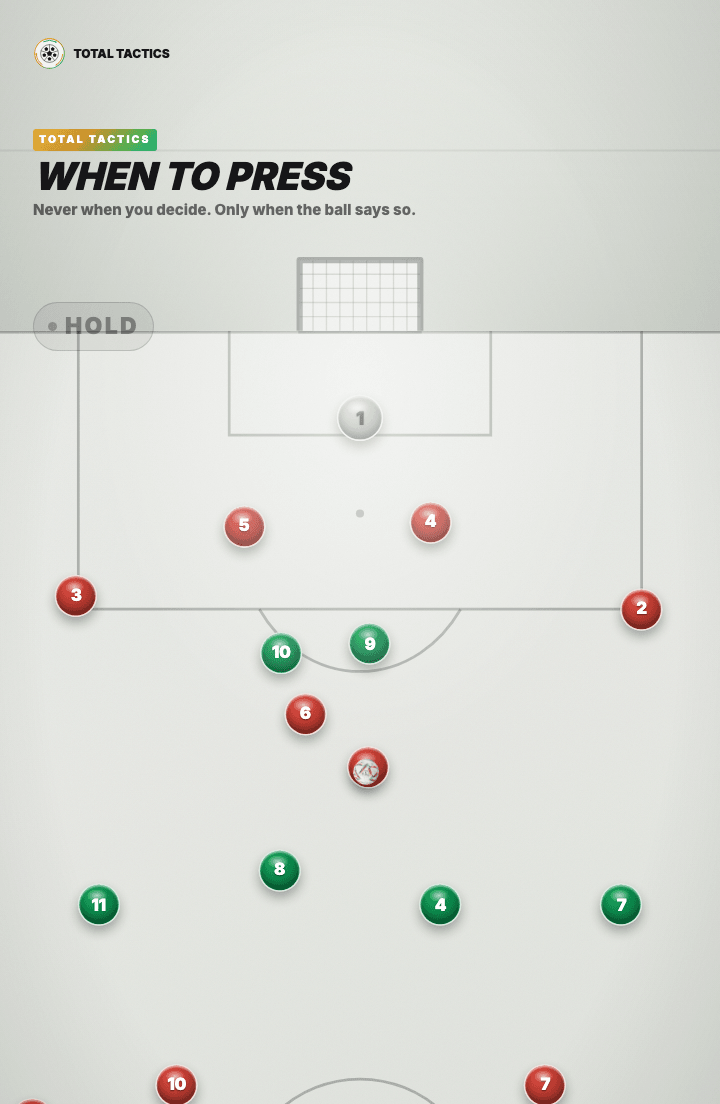
Phase 01 · Twenty-two players, a settled shape, and the state word reading HOLD.
The question nobody answers
Almost every pressing lesson shows a team winning the ball back. Very few answer the question a player actually has to answer in the moment, which is not how to press but when. The board starts with the honest picture: the opposition has the ball at the back, the shape is set, and the single word in the corner reads HOLD. Nobody is moving, and nobody should be. A press launched because a player felt like pressing is the fastest way to open your own team, because the ten men behind the presser have not been told it is happening. The rest of this page is one unbroken possession, and the word in the corner only changes four times.
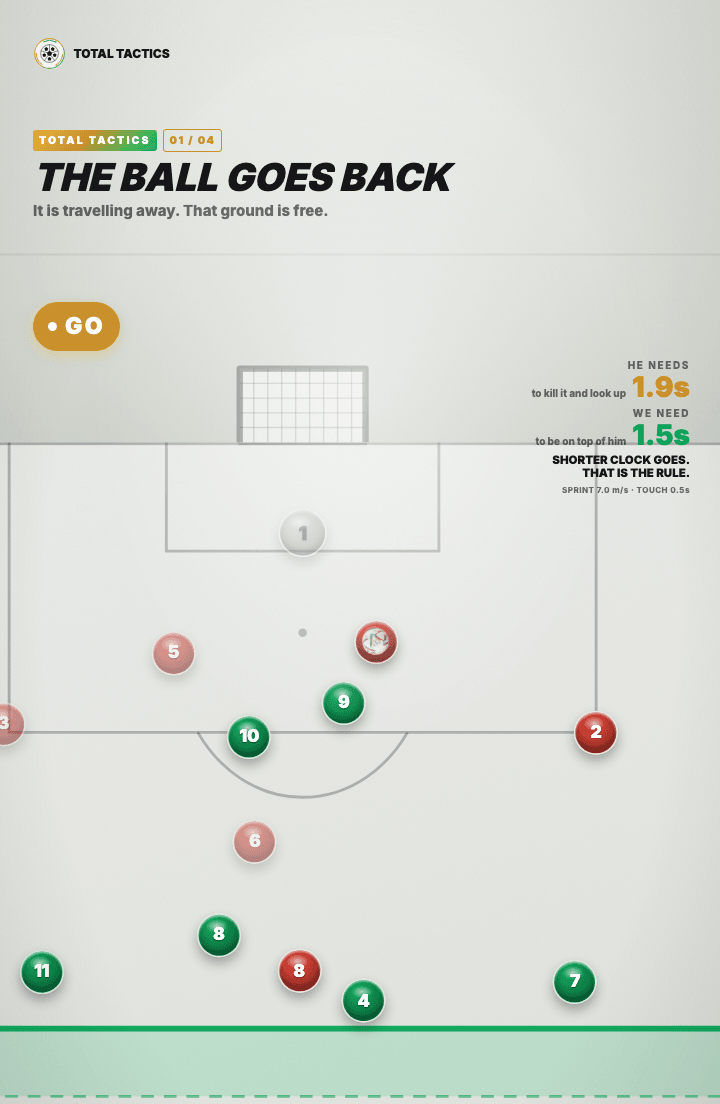
Phase 02 · It is travelling away from goal, so the ground in front of it is free.
Trigger one: the ball goes back
The first signal is a pass played backwards, and the board explains why with the only two numbers it will show you: he needs 1.9 seconds to kill it and look up, we need 1.5 seconds to be on top of him. Shorter clock goes. That is the entire rule, and it is a comparison rather than an instinct. A backward pass is a gift because it is travelling away from the goal being defended, which means the ground in front of it belongs to nobody for as long as it is in flight, and because the man about to receive it will be facing his own goal when he does. The state word flips from HOLD to GO, and it is the ball that flipped it, not the player.
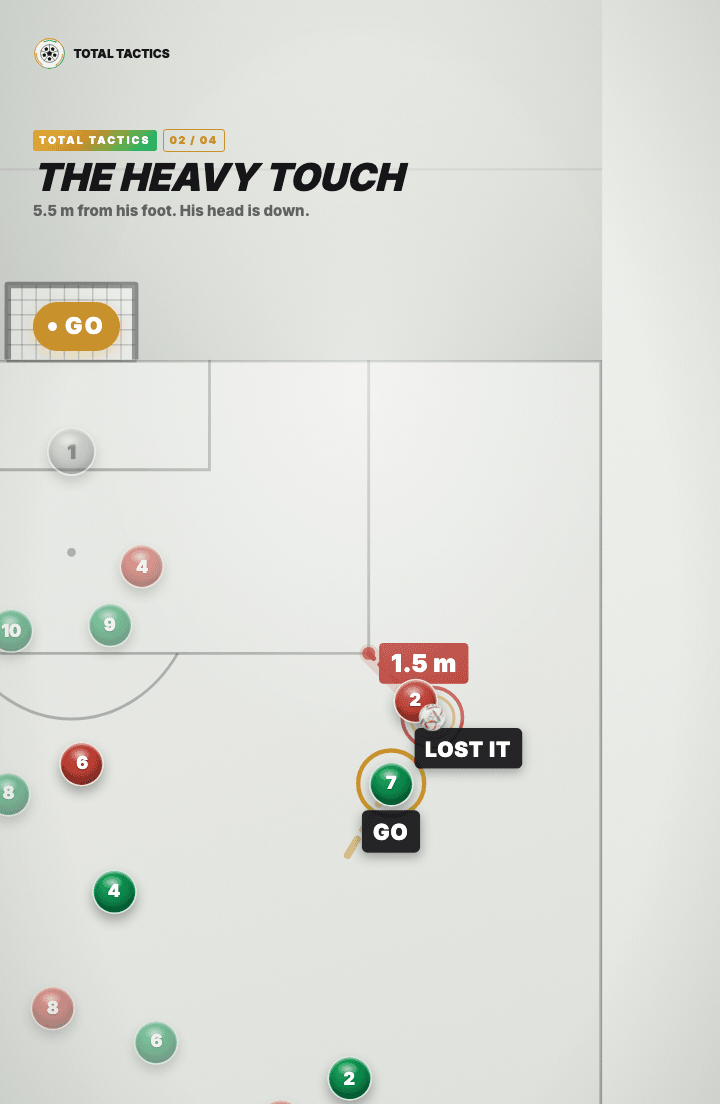
Phase 03 · The ball gets away from his foot and his head goes down.
Trigger two: the heavy touch
The second signal is a bad first touch, and the threshold is drawn rather than felt: the caption fixes it at five and a half metres between his foot and the ball. What makes it a trigger is not the distance itself but what the distance does to him. A player chasing his own touch has his head down, which means he cannot see a pass even if one exists, and he arrives at the ball moving away from where he wanted to go. The board tags him LOST IT and marks the nearest green player GO. Note that nobody has tackled anything yet. The press is simply arriving at a player who has, for about a second, no ability to punish it.
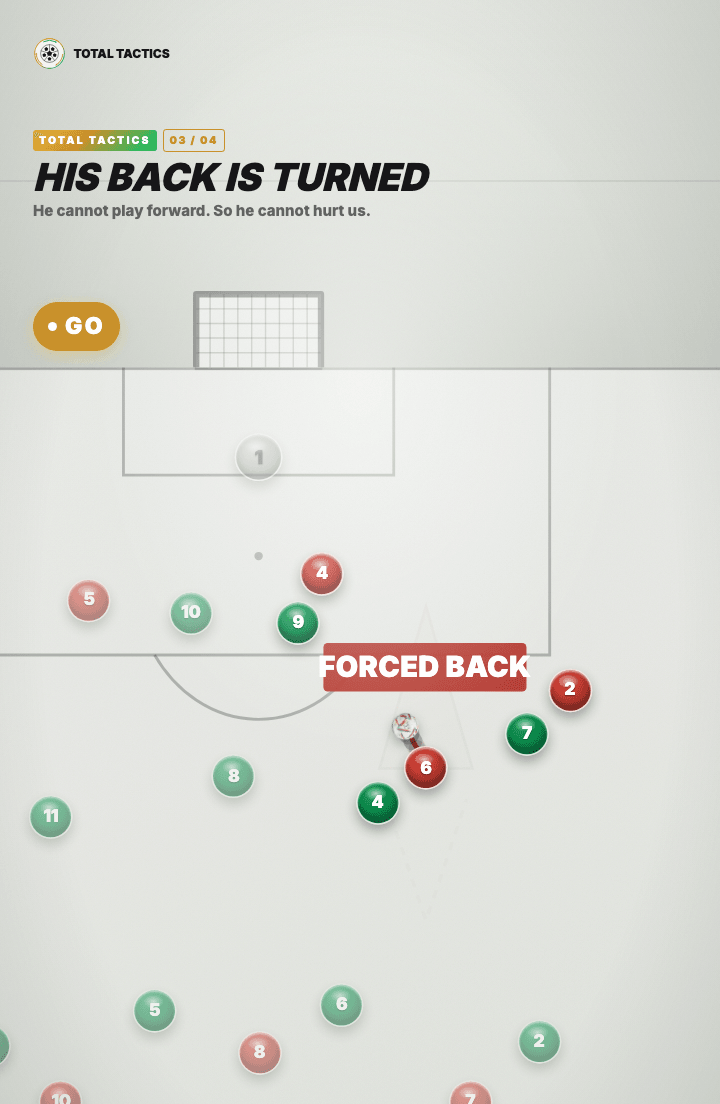
Phase 04 · He receives facing his own goal, so the forward pass does not exist.
Trigger three: his back is turned
The third signal is the cheapest of the four, because it requires nothing to go wrong for the opposition at all. A player who receives with his back to the goal he is attacking cannot play forward, and a player who cannot play forward cannot hurt you no matter how good he is. So you can arrive on him without any cover behind, which is normally the risk that makes pressing expensive. The board stamps the outcome FORCED BACK, and that word is the honest description of what has been achieved: not a turnover, just one more direction deleted. Three triggers in and the opposition have been pushed wide, then inside, then backwards, without a single duel being contested.
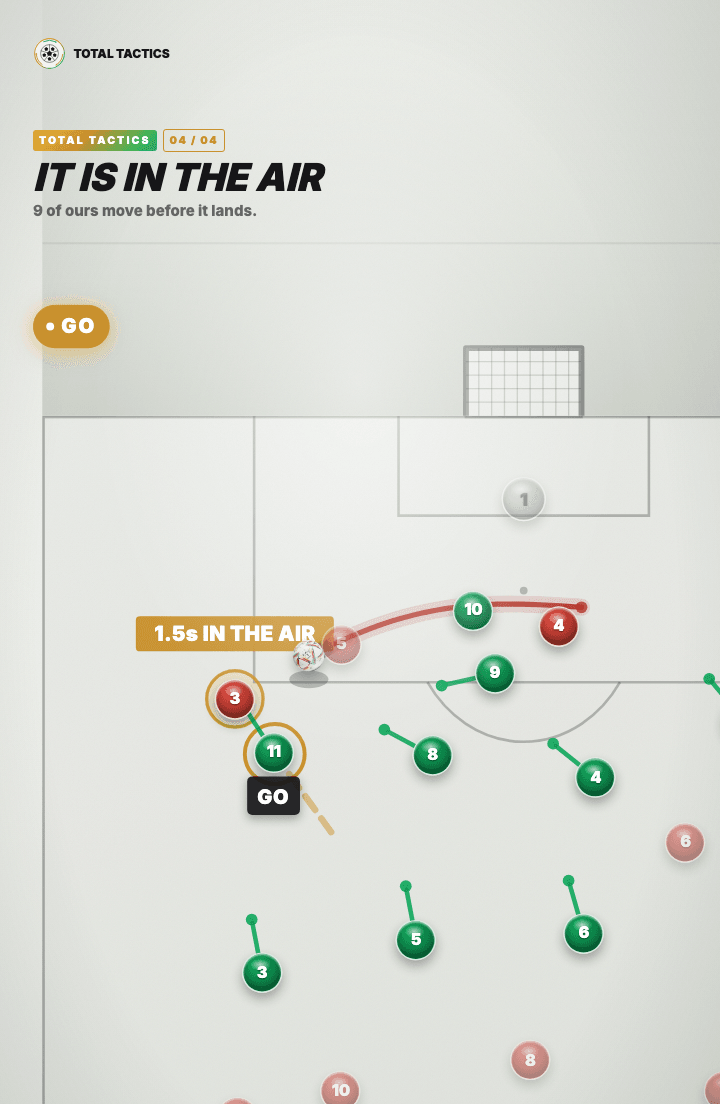
Phase 05 · One and a half seconds of flight, and nine of ours move before it lands.
Trigger four: it is in the air
The last signal is the one that wins it, and it is the only one that involves the whole team. The ball has been launched, and the board labels the flight time: one and a half seconds. That is not much for one player and it is an enormous amount for eleven, which is why every green token on this frame has a short line drawn out in front of it. Nine players are already moving to where the ball will land rather than watching it get there. A ball in the air cannot be recalled, cannot change direction and cannot be shielded, so the team that starts moving at the moment of contact arrives with numbers around the drop and the team that waits arrives one at a time.
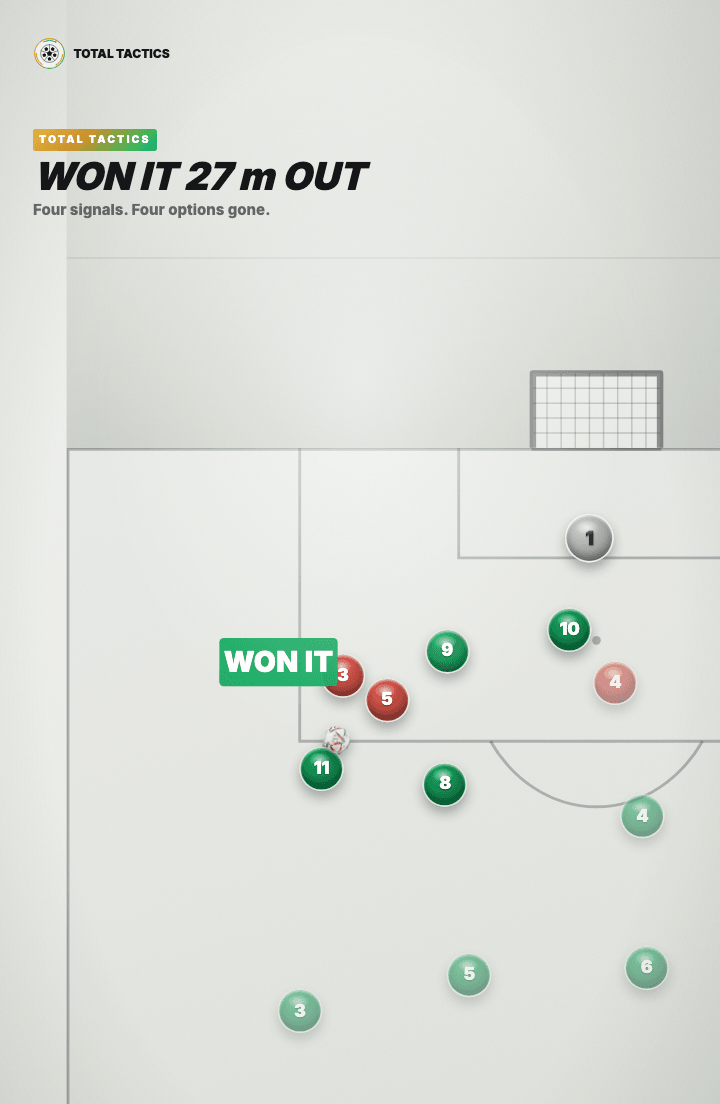
Phase 06 · Four signals, four options deleted, and the ball is theirs no longer.
Won it, twenty-seven metres out
The ball is won twenty-seven metres from the opposition goal, and the sub-line is the summary worth taking away: four signals, four options gone. Look back at what actually happened over the whole sequence. Nobody made a tackle until the very last moment. Each press deleted exactly one option (forced wide, then forced inside, then forced back) and the fourth trigger was simply the option they had left. That is the difference between pressing as an attitude and pressing as a system. A team that chases the ball spends its energy on the ninety per cent of moments where nothing is available. A team that waits for these four spends it only where the ball has already done half the work.
The principles
- 01
A press is a reaction, not a decision. If nothing triggered it, you are just running.
- 02
Compare two clocks: how long he needs to be safe against how long you need to reach him. Shorter clock goes.
- 03
Each trigger only deletes one option. Four of them in a row is what actually wins the ball.
What are the pressing triggers in football?
Four. The ball has been played backwards, it has got away from someone’s foot, the man receiving it has his back turned, or it is in the air. Each one buys a second in which the player on the ball cannot punish you for arriving.
When should you not press?
Whenever nothing has triggered it. A press is a reaction, not a decision. If the ball has not told you to go, you are just running, and the shape you left behind is the one they play through.
How do you know you will reach the ball in time?
Compare two clocks: how long the man on the ball needs in order to be safe, against how long you need to reach him. Shorter clock goes. Each trigger only deletes one of his options, which is why several of them stacked in a row is what actually wins the ball.
Next
Get the next one.
One system a week, drawn and explained the same way.