Build-up · 6 phases
Playing Out From The Back
You make an extra man. A man-to-man press has one presser for every player, so the fix is to field one more passer than they have pressers: the centre-backs split and the goalkeeper steps into the line, making three against two. Then invite a presser in, because every man who comes to the ball leaves the man he was marking free.
- Phases
- 6
- Original
- 33s
- Updated
- Aug 2026
Swipe to change phase
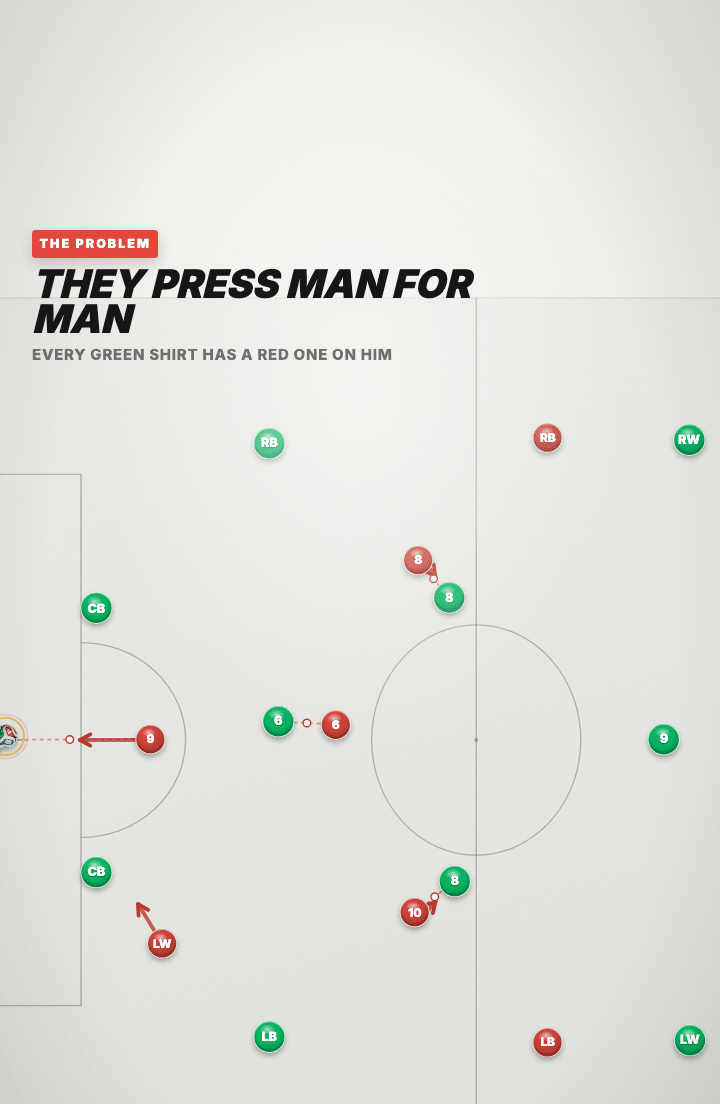
Phase 01 · Every green shirt has a red one attached to it, all the way up the pitch.
They press man for man
The board opens with the hardest version of the problem. This is not a block waiting to be played through: it is a man-to-man press, and the short red lines drawn on the diagram are the marking assignments, one red shirt hooked onto every green one from the centre-backs to the wingers. There is no free man anywhere on the pitch, and that is what makes this so uncomfortable to play against. A team facing a zonal block can move the ball until a gap appears. A team facing this has no gaps to wait for, because the shape is not arranged against the pitch at all. It is arranged against the players. Which is also, as it turns out, the weakness.
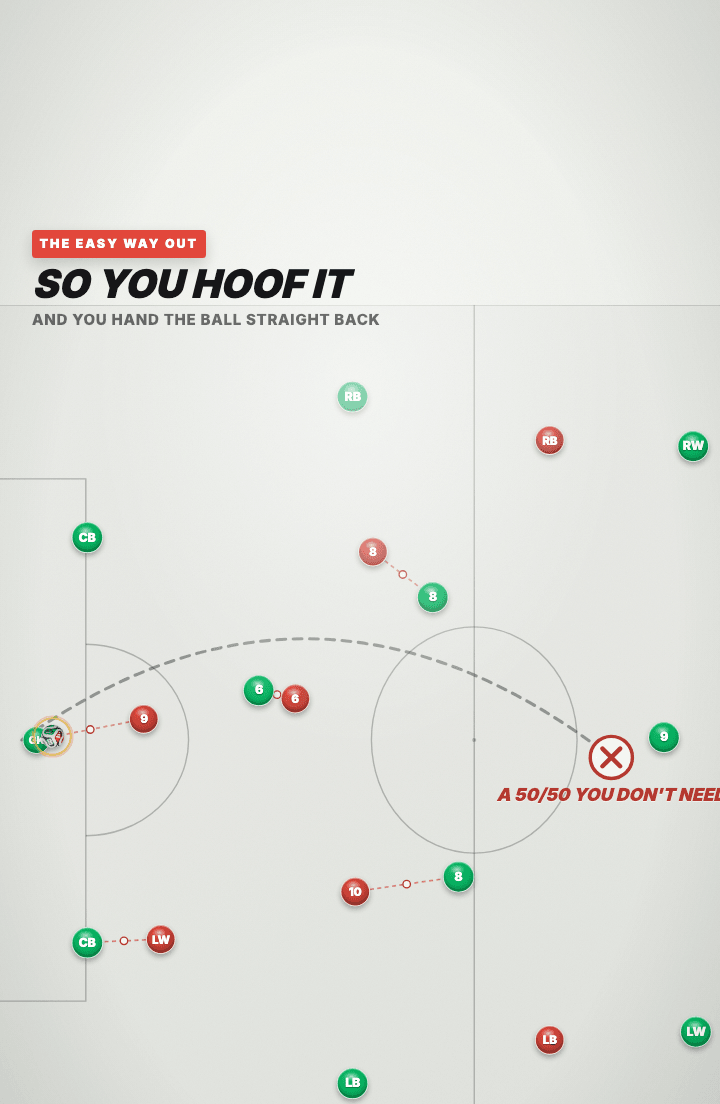
Phase 02 · The easy way out, drawn and then crossed off.
So you hoof it
The instinctive answer is the long one: put it in the sky, let the striker compete, and accept whatever happens. The board draws that pass as a grey arc and stamps it with a cross, and the label is the whole objection. A ball launched into a fifty-fifty is not safety, it is a coin flip you did not have to toss. You had the ball and full control of it, and you have converted that into an even-money contest sixty metres from your own goal, against defenders who are facing the right way and attacking it while your striker is moving backwards. Sometimes it is the correct choice. It is never a plan, and this short exists to show what a plan looks like.
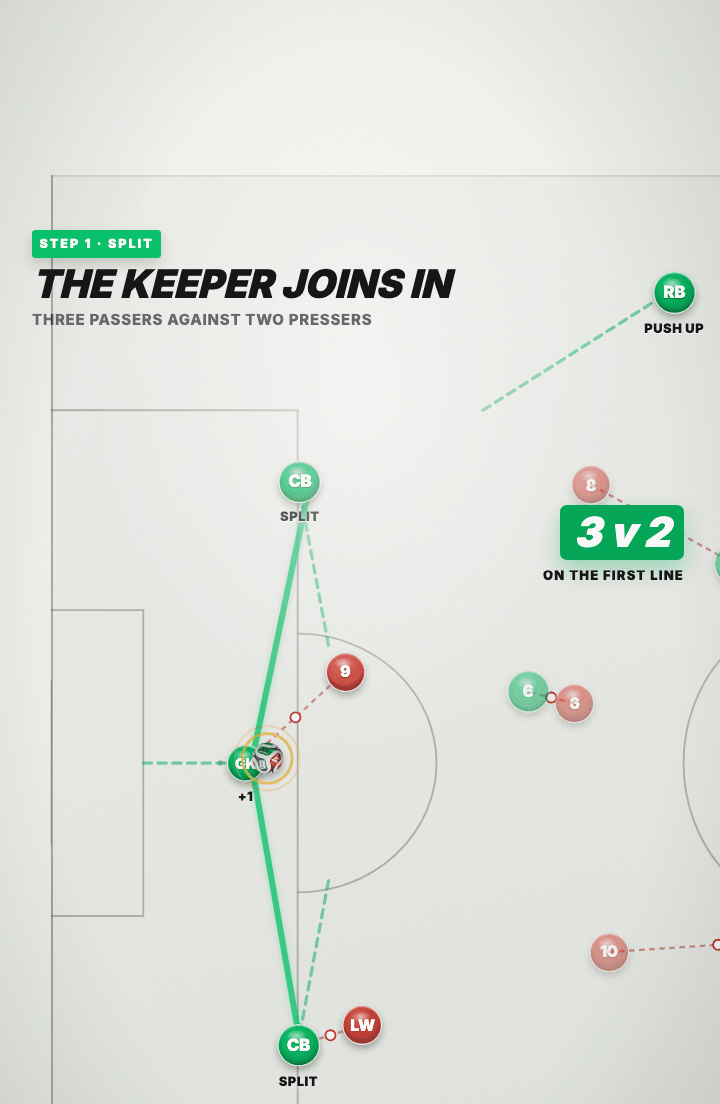
Phase 03 · The centre-backs go wide, the goalkeeper joins the line: three against two.
Split, and let the keeper in
Now the fix, and it is arithmetic rather than courage. The two centre-backs split to the edges of the penalty area, marked SPLIT on the board, and the goalkeeper steps up between them, marked +1. That is three players on the first line against the two forwards who are pressing it, and the board says so directly: three against two. Notice what else moves. Both full-backs push up the pitch, which drags their markers with them and empties the ground the build-up needs. Nobody in this picture has done anything technically difficult. Two defenders walked sideways and a goalkeeper walked forward, and the press is now one body short of covering the players in front of it.
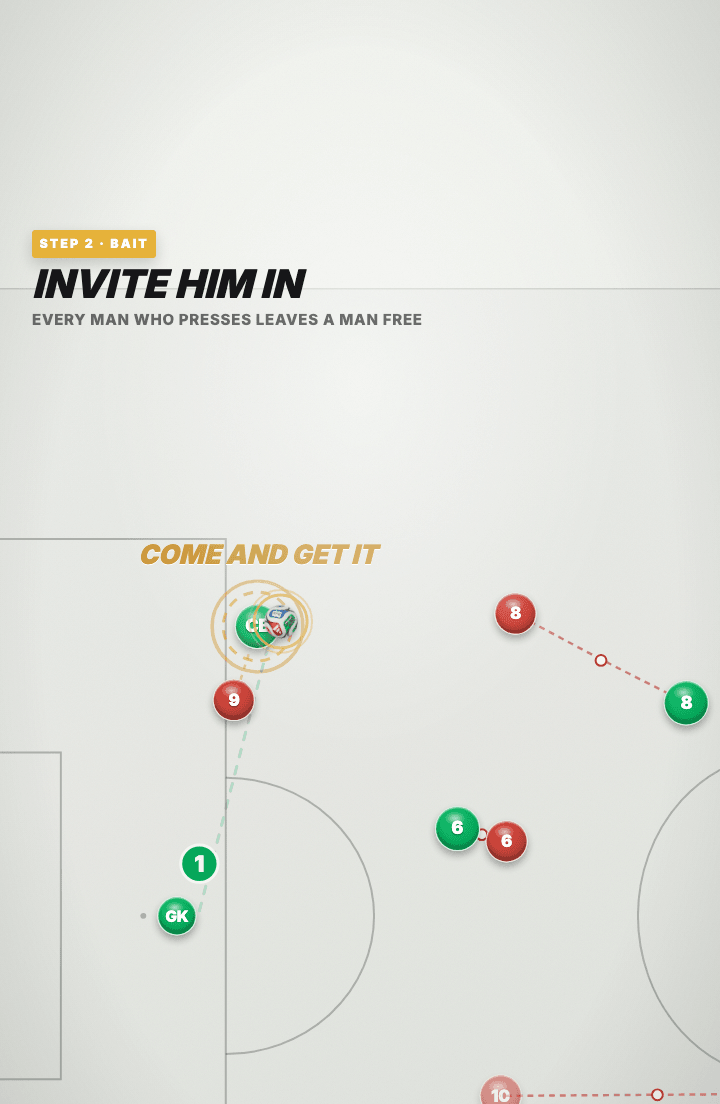
Phase 04 · The ball goes to a centre-back, and the presser has to come.
Invite him in
A spare man is only worth something if the opposition commits, so the next move is bait. The ball is played to one centre-back and held there, ringed in gold and captioned come and get it. Their forward has no choice: leave a man on the ball at the edge of the box and he is inviting a carry into midfield. So he goes. And the instant he goes, the player he had been marking is unmarked, because a man-to-man press has nobody spare to hand him over to. That is the mechanism the whole pattern is built on, and it is worth stating plainly: every man who presses leaves a man free. You are not beating the press. You are asking it to dismantle itself one runner at a time.
Phase 05 · Into the pivot’s feet, marked from behind, and set straight back.
One touch, because he cannot turn
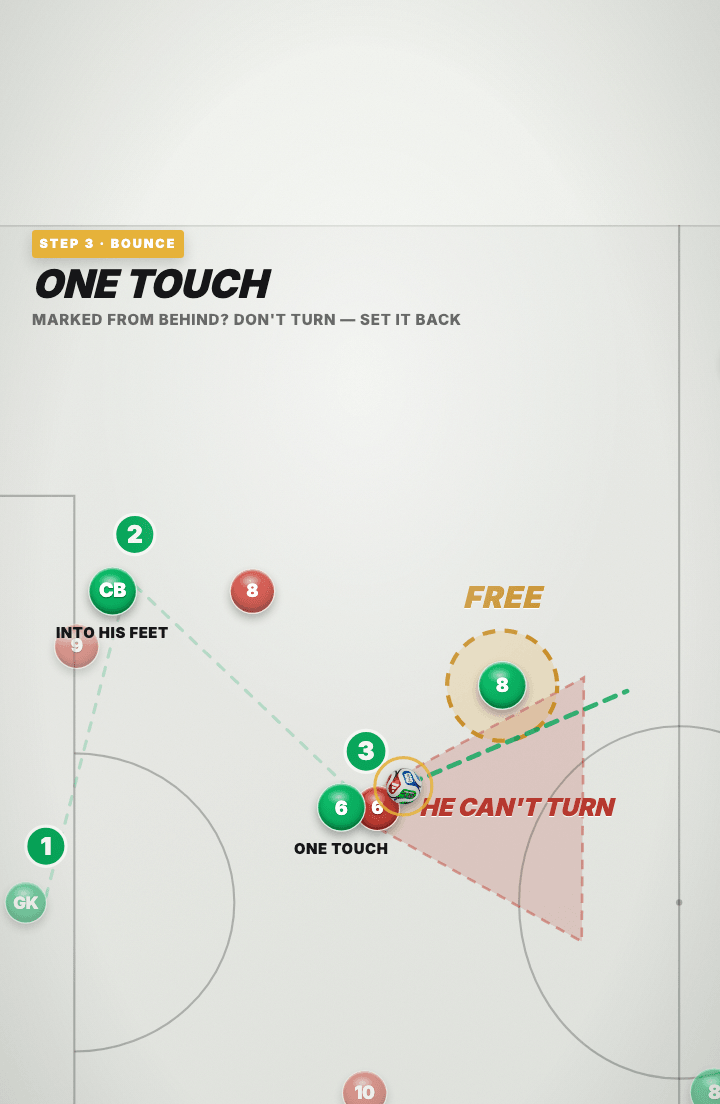
The pass goes into the holding midfielder, and it goes into his feet on purpose. He is marked from behind, and the board draws the consequence as a red wedge: the whole forward half of the pitch is a direction he cannot take. So he does not try. He plays it first time, one touch, into the space beside him, where the midfielder ringed in gold and labelled FREE is standing facing the right way. This is the least spectacular pass in the sequence and the one that beats the press. A midfielder who receives under pressure and attempts to turn is how possession is lost in the worst area of the pitch; a midfielder who receives and sets it back has used his marker as a wall.
Phase 06 · The whole move drawn on one board: split, bait, one touch, in behind.
Four passes, no fifty-fifties
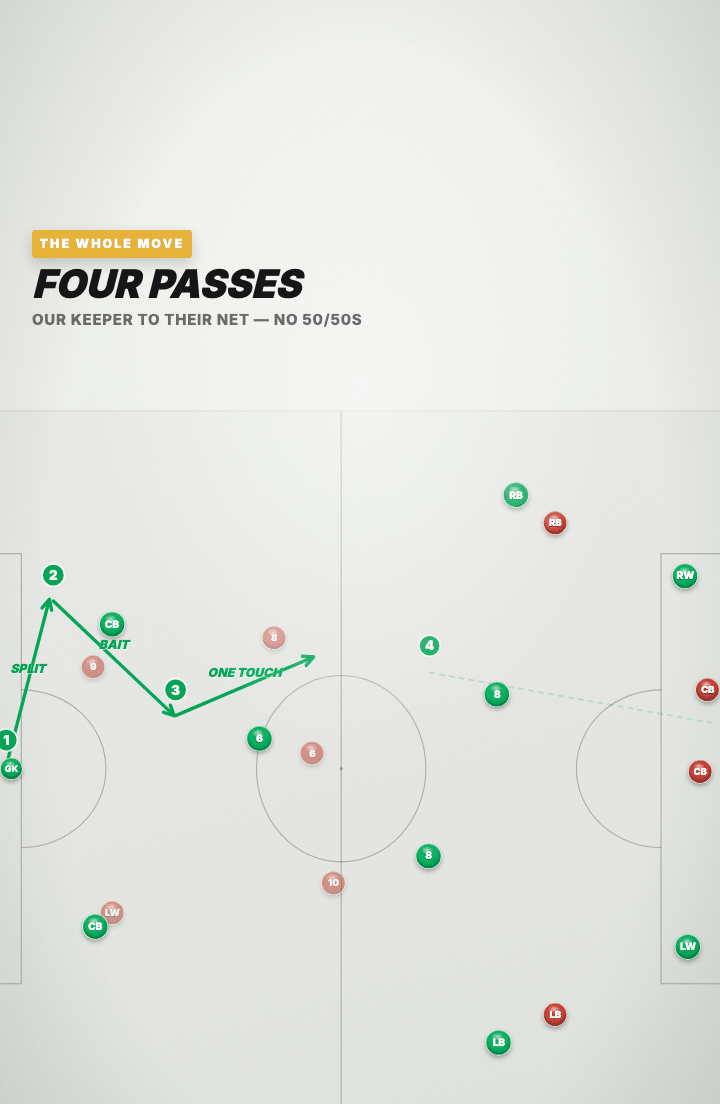
The recap puts the entire sequence on a single pitch, each pass numbered and named. One: goalkeeper to the split centre-back. Two: the bait, held until the presser commits. Three: one touch into the free man. Four: in behind, into the space their own press left when it pushed up. Four passes from the goalkeeper’s hands into the opposition’s defensive third, and not one of them was a contest. That is the honest argument for building this way over hitting it long. It is not that playing out is braver. It is that a team pressing man for man has committed everybody, so the pass that beats the last presser is also the pass that beats the entire team.
The principles
- 01
Man-to-man presses die to arithmetic. Add one passer and the marking runs out of bodies.
- 02
The goalkeeper is a player. Refuse to use him and you are voluntarily a man short.
- 03
Marked from behind? Do not turn. One touch back to the man who can see the whole pitch.
How do you beat a man-to-man press?
By making an extra man. A man-to-man press has one presser for every player, so you field one more passer than they have pressers: the centre-backs split wide and the goalkeeper steps into the line, and it is three against two.
Should the goalkeeper join the build-up?
Yes. The goalkeeper is a player, and declining to use him is volunteering to be a man short in the one part of the pitch where being a man short costs a goal directly.
What should a midfielder do when he is marked from behind?
Not turn. One touch straight back to the man who can see the whole pitch, and let him play the pass that cannot be seen from a back-to-goal position. That single bounce pass is what beats the press on this board.
Next
Get the next one.
One system a week, drawn and explained the same way.