Build-up · 6 phases
The Salida Lavolpiana
You change the arithmetic. Two forwards pressing two centre-backs is a coin flip, so the holding midfielder drops between the centre-backs to make a back three. Two pressers cannot cover three players, which means one is always free, and he steps through the centre the pressers have just vacated.
- Phases
- 6
- Original
- 42s
- Plays
- 66,000
- Updated
- Aug 2026
Swipe to change phase
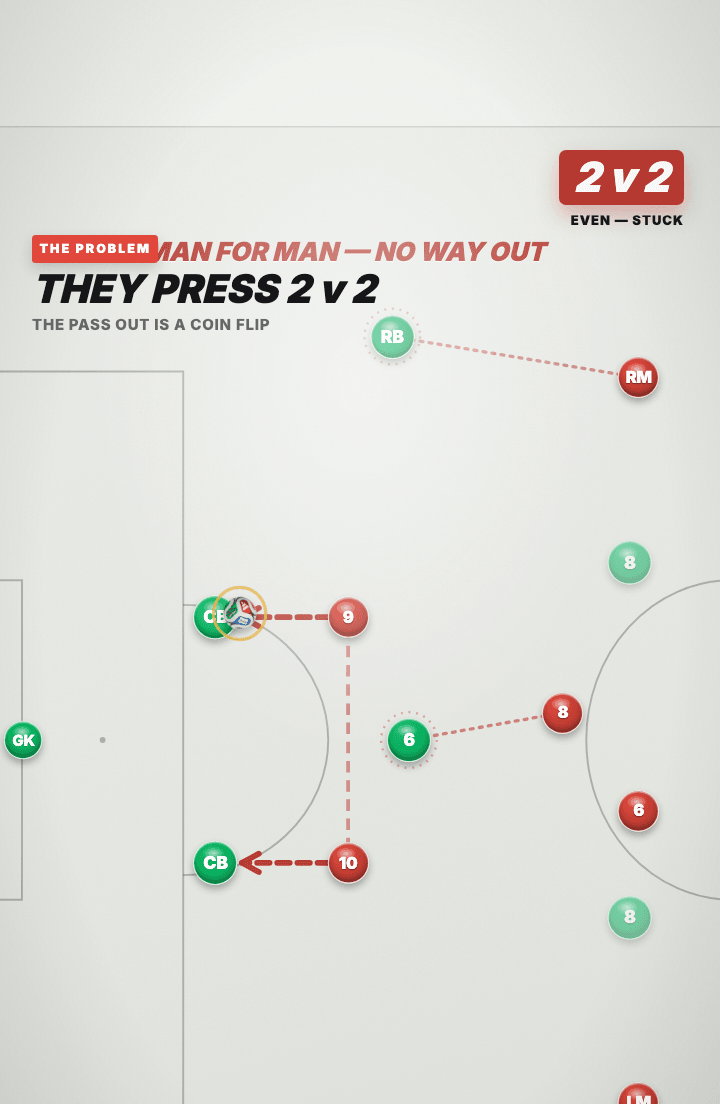
Phase 01 · Two forwards, two centre-backs, and no clean way out.
The problem: two against two
Start where most teams lose the ball. The goalkeeper has it, two centre-backs are split either side of the box, and two opposition forwards are pressing them. That is two against two, and two against two is a coin flip: whichever centre-back receives, a presser arrives with him, and the pass has to be made under pressure with the goal directly behind. Teams respond to this by hitting it long and giving the ball away in a fairer position, or by playing through it and occasionally conceding in the worst place on the pitch. Neither is a plan. The problem is not the players’ nerve; it is the number.
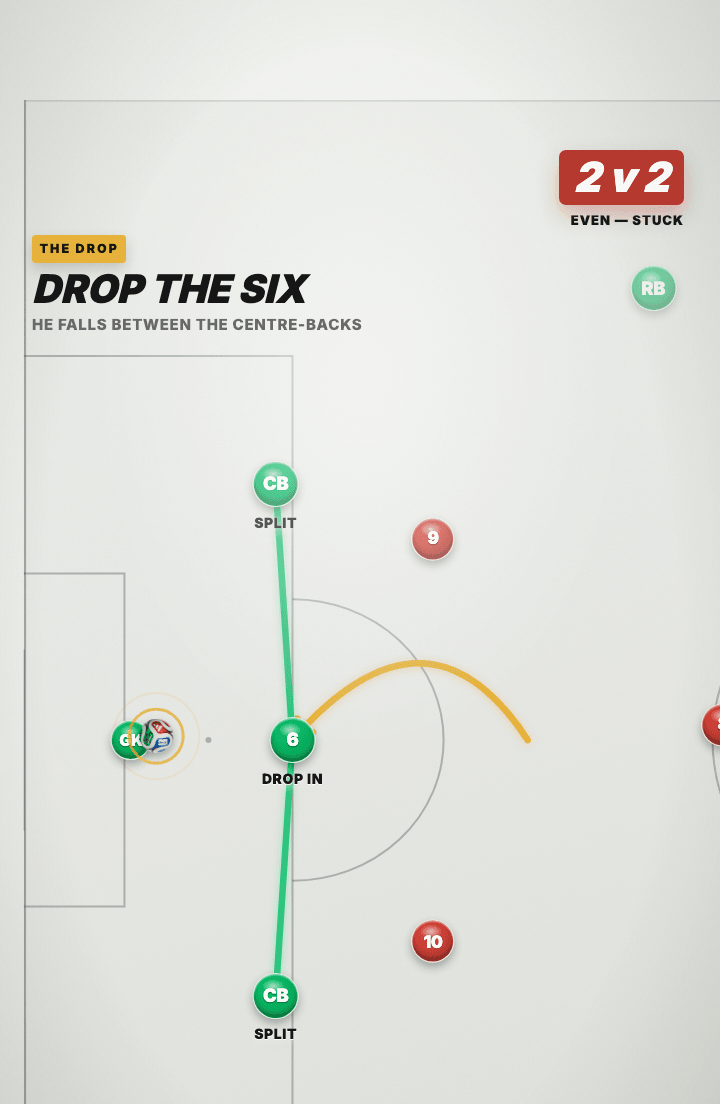
Phase 02 · The holding midfielder falls in between the centre-backs.
Drop the six
The fix is one movement. The holding midfielder, the six, drops out of midfield and takes up a position between the two centre-backs, who spread wider to make room. What was a back two is now a back three, built in the moment the press commits rather than set up in advance. Note that nothing about this requires a special player or a rehearsed pattern. It is a body arriving in a place where the opposition has not allocated anyone, and the reason it is named after Ricardo La Volpe is simply that he was the one who insisted on doing it deliberately, every time, rather than as an improvisation.
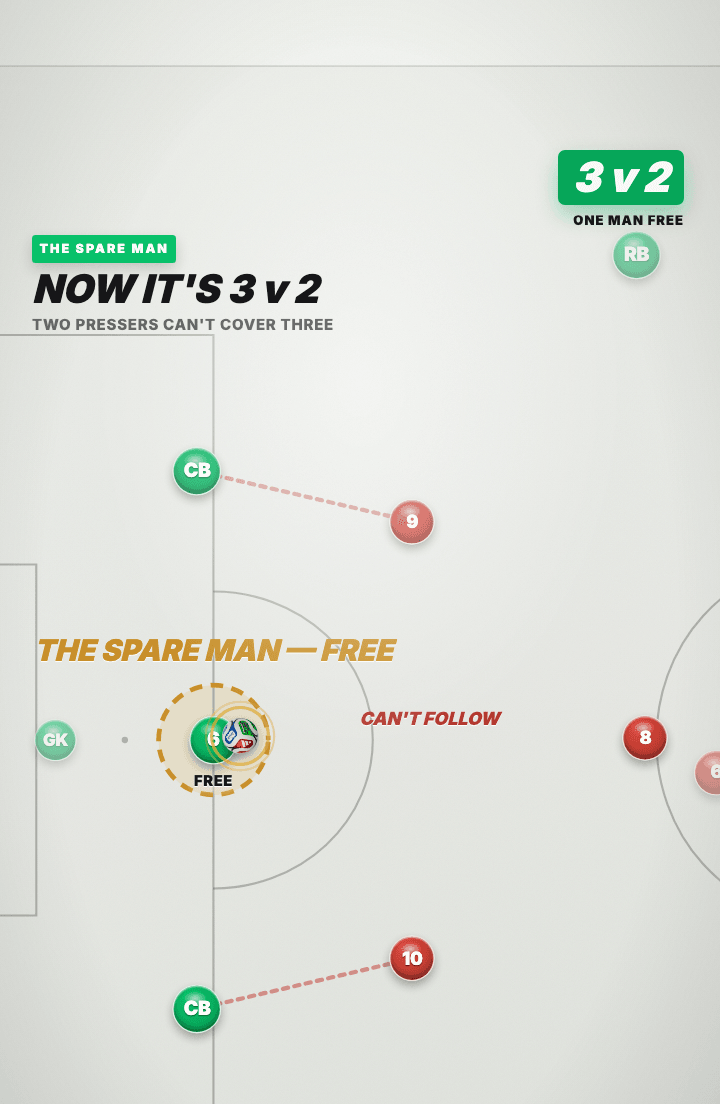
Phase 03 · The board says it outright: one man free.
Three against two
Now count. Three players building, two players pressing. Two pressers can cover two men; they cannot cover three, and the board rings the spare one in gold and labels him free. The opposition’s midfielders are marked as unable to follow: if one of them steps forward to make it three against three, he leaves a hole in the middle of their own team, which is a worse problem than the one he is solving. This is the whole idea, and it is worth being precise about it: the free man was not found. He was created, by adding a body the press had not accounted for.
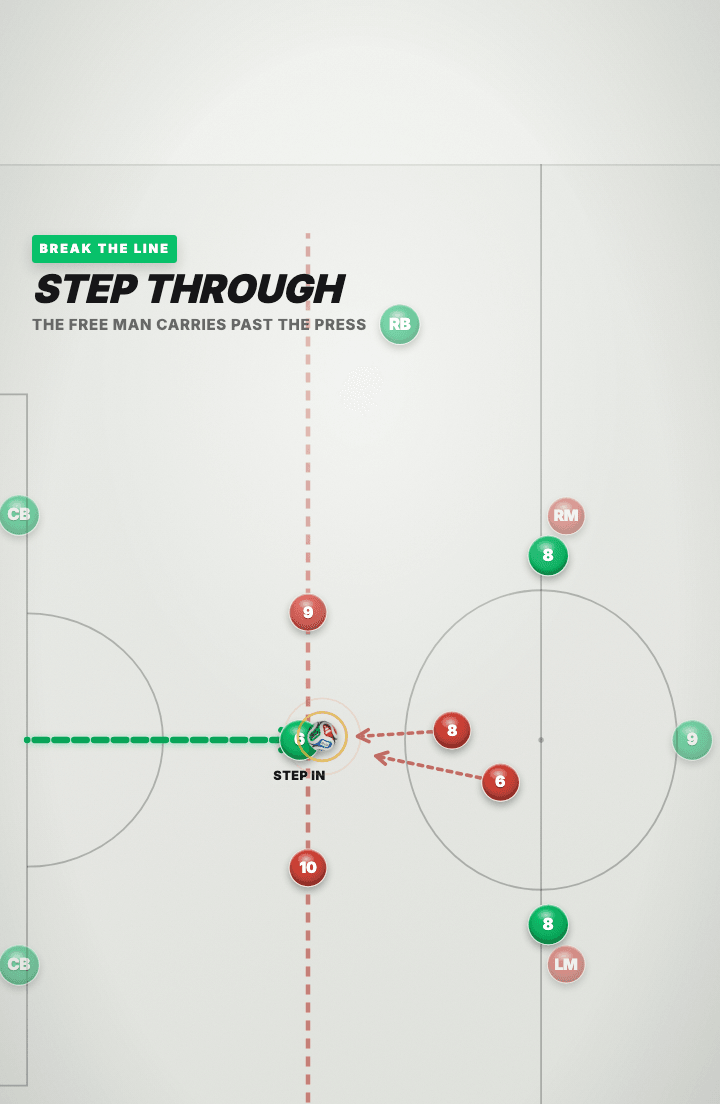
Phase 04 · The free man carries into the space the pressers left.
Step through the line
The free man does not just receive; he carries. When the two forwards pressed, they ran past the space they had been standing in, and that space is now the most valuable ground on the pitch: directly through the middle, behind their first line, with nobody in front of the ball. So he steps into it. A pass here would let the defence reset; a carry drags their midfield toward him and forces someone to commit. The board stamps the outcome as the line being broken, which is the honest description. Two opposition players have been taken out of the game by one player walking forward.
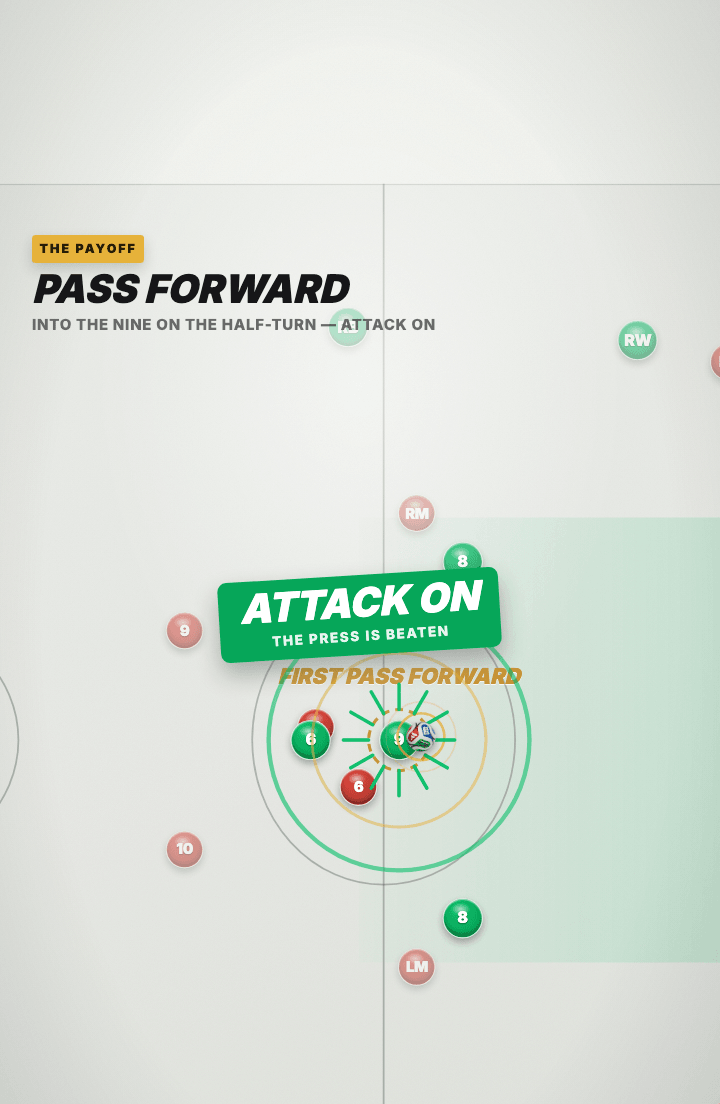
Phase 05 · Into the striker on the half-turn: the press is beaten.
The first pass forward
With the first line gone and their midfield pulled toward the ball, the pass forward finally exists. It goes into the striker, who receives on the half-turn rather than with his back to goal, the small detail that turns a possession statistic into an attack. The sequence is now over and worth counting: the opposition committed two players to pressing and got nothing, the defending team has moved the ball from its own six-yard box into the opponent’s half in four passes, and the whole thing was triggered by one midfielder walking backwards ten metres.
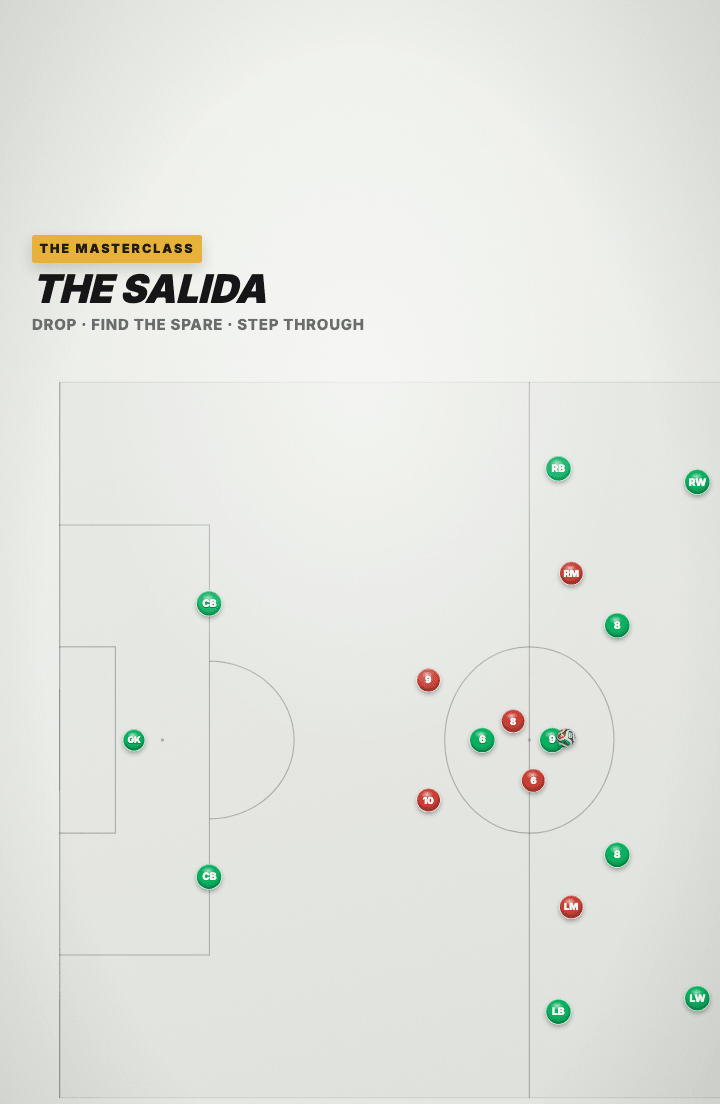
Phase 06 · Drop · find the spare · step through.
The masterclass, in three moves
The recap is three words long because the pattern is three moves long. Drop the six between the centre-backs. Find the spare man that the extra body creates. Step through the centre the pressers vacated. Every elite side at the World Cup does some version of this, and the variations are mostly about who drops (a full-back inverting, a centre-back stepping out, a second midfielder joining) rather than about the principle. The principle never changes: if the press has a number, beat the number before you try to beat the player.
The principles
- 01
Build-up is arithmetic before it is technique. Add a body and the press stops working.
- 02
The free man is created by the drop, not found by luck: two pressers cannot cover three.
- 03
When a presser steps out, he leaves the space he was standing in. Play through that space.
What does “Salida Lavolpiana” actually mean?
It is named after Ricardo La Volpe, the coach whose signature it became. Stripped of the name, it is one movement: the holding midfielder drops between the two centre-backs to build from the back, turning a back four into a back three with the ball.
Which player drops between the centre-backs?
The holding midfielder, the six. Once he is in the line, two pressing forwards are facing three passers, and one of the three is free by arithmetic rather than by luck.
Isn’t building from the back like this just inviting pressure?
It invites it deliberately. Every presser who steps out leaves the ground he was standing in, and that ground is where the free man carries the ball. The risk is real but it is the smaller one: the alternative is a fifty-fifty in the air and possession handed back.
Next
Get the next one.
One system a week, drawn and explained the same way.