Defending · 6 phases
The Back Four Reset
Because a backward pass is free time. Nobody has to be marked while the ball is travelling back to the opposition’s holding midfielder, so the line uses that half second to square up and step two and a half metres higher. Do it four times and the same four defenders are eight metres up the pitch, with less ground behind them and a smaller hole every time one of them jumps out.
- Phases
- 6
- Original
- 22s
- Updated
- Aug 2026
Swipe to change phase
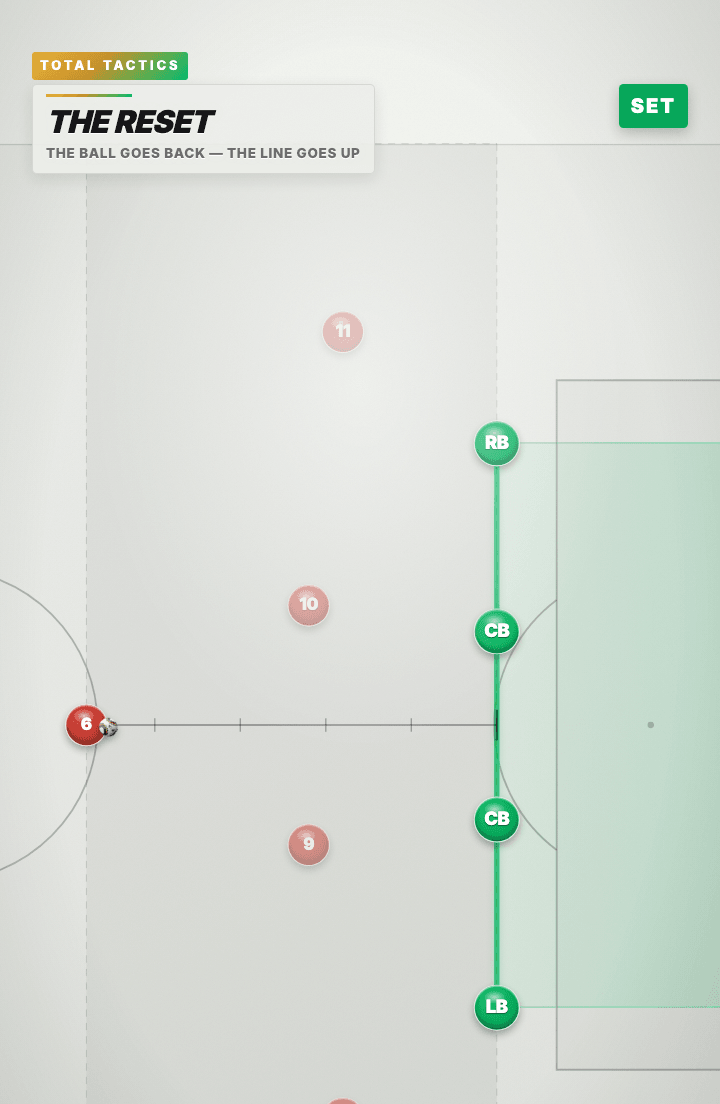
Phase 01 · Four defenders in a flat line, the goal on the right, the ball on their pivot.
Set, and waiting for the ball to go back
The board is a defending half turned on its side: the goal being protected is on the right, the four green defenders are joined into one vertical line, and the shaded strip behind them is the ground they are responsible for. The ball is on the opposition’s holding midfielder, out at halfway on the left, and the ruler drawn between him and the line is the number this whole system is about. The state chip in the corner reads SET, which is the only moment in the next twenty seconds when nothing is happening. Everything from here is one movement repeated: the ball goes out to a man, that man is pressed, the ball comes straight back to the pivot, and the line does something with the half second that buys.
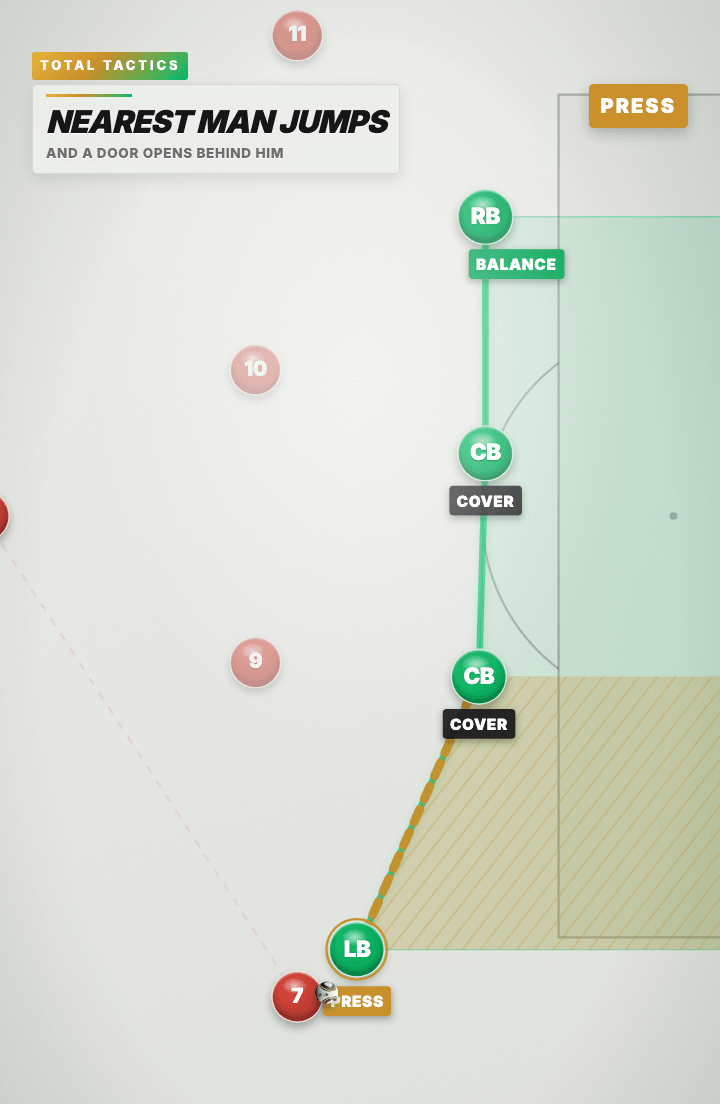
Phase 02 · The left-back steps out to press, and the channel he leaves is shaded gold.
The nearest man jumps, and a door opens
The ball goes out wide and the nearest defender jumps to it. That part is uncontroversial: the left-back steps out to PRESS, and the two centre-backs beside him take COVER while the far full-back holds BALANCE, which is the pattern from the original back four clinic. What this board adds is the cost, drawn rather than described. The channel the presser has just vacated is shaded gold and hatched, and it is measured live from the two defenders either side of it, so the gold is not decoration: it is the actual width of the door his run has opened. Every press does this. The question the rest of the sequence answers is not how to avoid opening the door, but how to make it small enough not to matter.
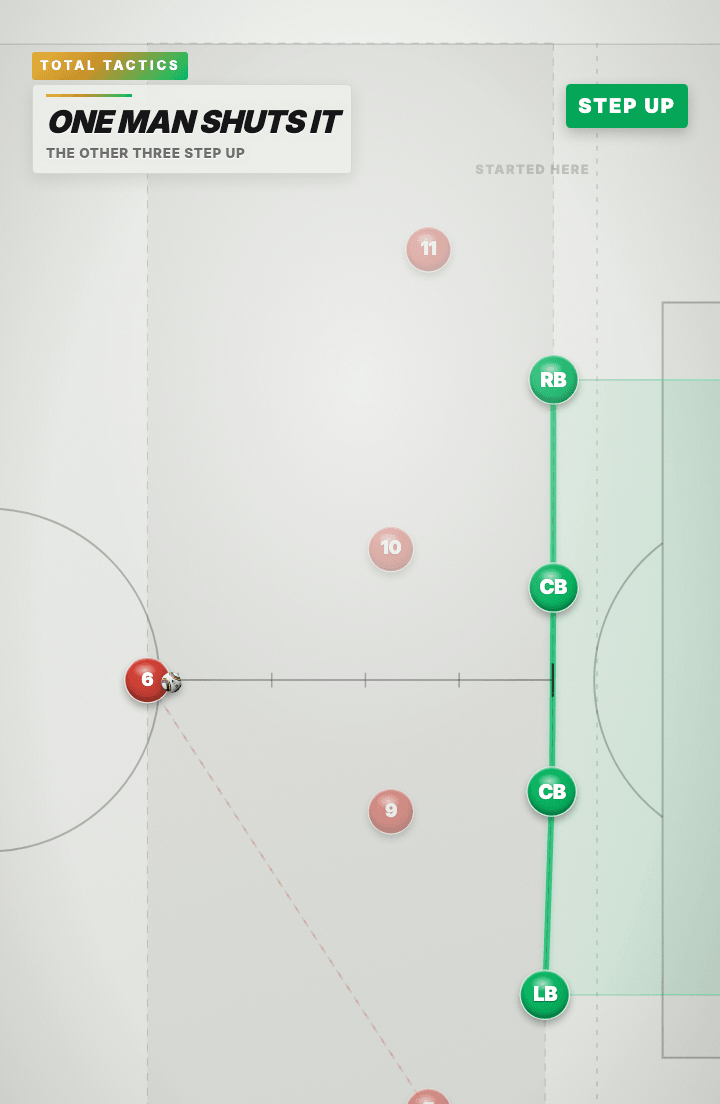
Phase 03 · Nobody chases the backward pass; the four square up and step forward together.
The ball goes back, the line goes up
The winger has no forward option, so he plays the ball back to the pivot at halfway. This is the moment the short exists for. Nobody presses it. Chasing a pass backwards is thirty metres of running to arrive out of breath at a player facing his own goal, and the ball will simply be moved again before you get there. Instead the four defenders use the second and a half the ball spends travelling to do two things at once: the presser returns to the line so the four are square again, and the whole unit steps two and a half metres up the pitch. The dashed marker labelled STARTED HERE is where they were standing before this rep, left on the board so the gain is visible rather than claimed. The state chip now reads STEP UP.
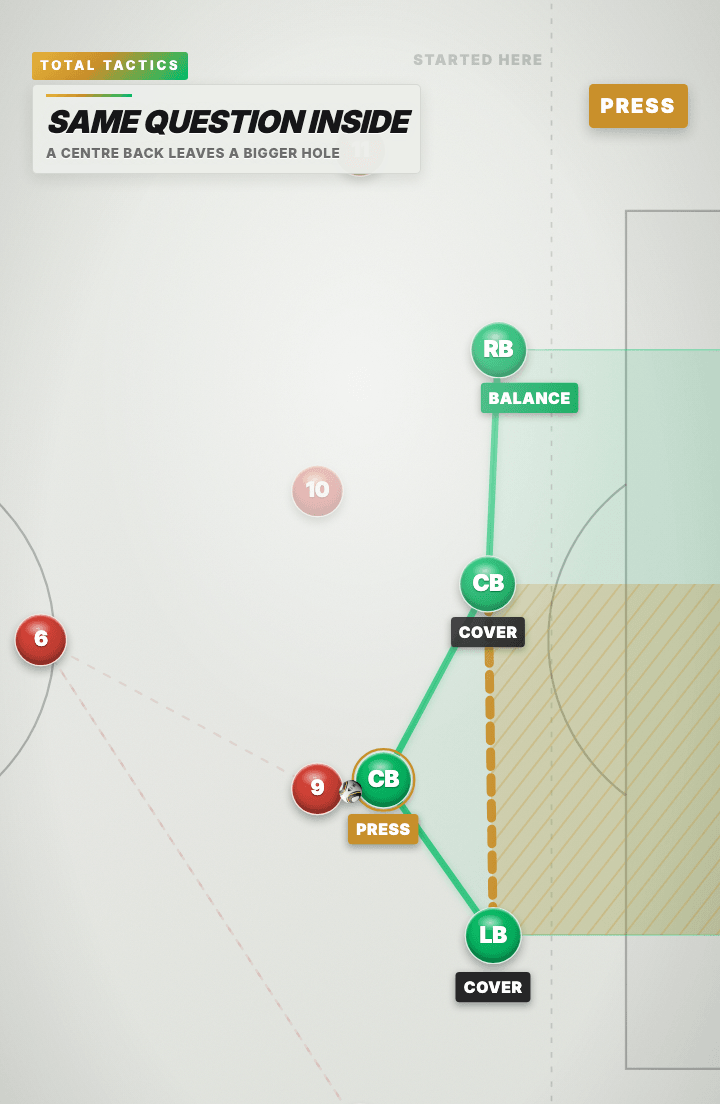
Phase 04 · A centre-back jumps this time, and the hole he leaves is a bigger one.
Same question, asked inside
The second rep goes into the middle instead of down the line, and the job falls to a centre-back. He steps out to press the striker and the same gold channel appears behind him, except that it is wider now, because a centre-back leaving the line opens a hole in the centre of the goal rather than at the edge of it. Both his neighbours drop into COVER, one above and one below, exactly as they would in any back four. The point of running the pattern a second time from a different starting position is that the viewer can now predict both halves of it: who jumps, and that the line will not drop afterwards. By rep three that prediction is the whole lesson.
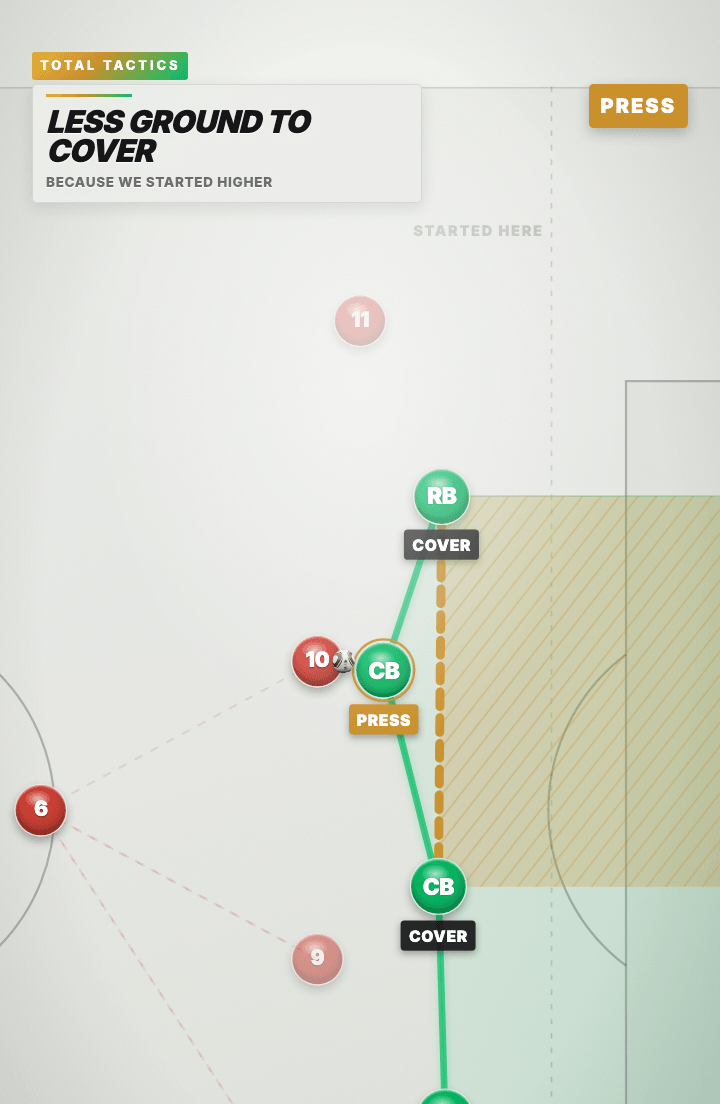
Phase 05 · The third rep, from a starting line already several metres higher.
Less ground to cover
Third time out, and nothing about the movement has changed. What has changed is where it starts from. The line is now clearly ahead of the STARTED HERE marker, which means the defender who jumps has less distance to travel to reach the ball, gets there sooner, and is therefore out of the line for less time. The gold channel behind him is correspondingly smaller. This is the compounding part of the system and the reason it is worth doing deliberately rather than occasionally: each reset makes the next press cheaper. A back four that drops back to its starting position after every rep pays the same price four times. A back four that keeps the ground it won pays less each time.
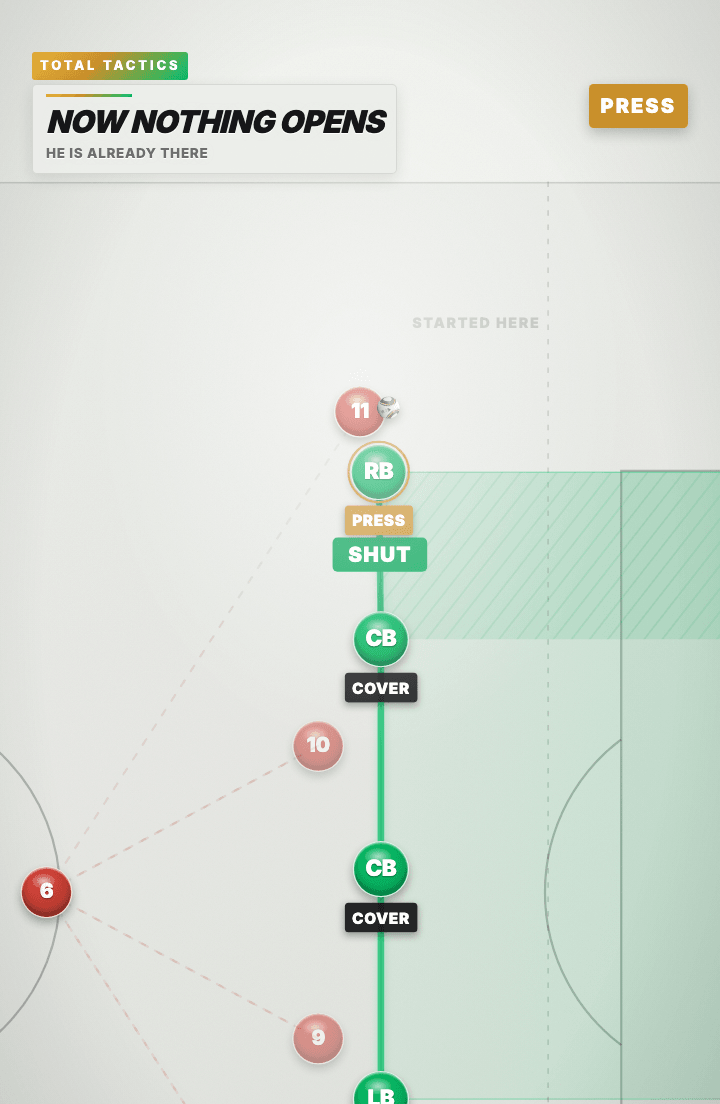
Phase 06 · The fourth rep: the presser is already there, and the channel is shaded green.
Now nothing opens
The fourth ball goes wide to the far winger and the right-back meets it almost where he was standing. He has barely left the line, because eight metres of accumulated ground means the man he has to press is now inside the shape rather than beyond it, and the channel behind him is shaded green and stamped SHUT instead of gold. That is the whole system in one frame. Nothing here is about tackling, aggression or reading the game. It is four players agreeing that a ball travelling backwards is time nobody is using, and spending it, every single time, on the two and a half metres that make the next press free.
The principles
- 01
Every pass backwards is free time. Spend it squaring the line up, not catching your breath.
- 02
One man goes to the ball. The other three do not follow him out; they step forward together.
- 03
The higher the line starts, the smaller the hole the presser leaves. Height fixes it, not speed.
Why does a defensive line step up when the ball goes backwards?
Because a backward pass is free time. While the ball is travelling away from goal there is nobody who has to be marked, so the four use that half second to square up and step about two and a half metres higher. Do it four times and the same defenders are eight metres up the pitch.
Should anyone chase the pass back?
One man goes to the ball. The other three do not follow him out; they step forward together. A line where everybody chases is a line with an open channel behind whoever moved first.
How do you stop a gap opening when a defender steps out to press?
With height rather than speed. Every time a defender jumps out, the channel he was standing in opens behind him; the higher the line was when he went, the less ground there is for that channel to be. By the fourth reset the presser is already there and nothing opens at all.
Next
Get the next one.
One system a week, drawn and explained the same way.