The extra man
Build-up is arithmetic before it is technique. Two ways to make three against two, and what the pressing team does about it.
Most coaching about playing out of the back is about technique: body shape, the weight of the pass, the first touch away from pressure. All of it true, all of it downstream of a sum that has usually already been lost.
Two forwards pressing two centre-backs is two against two. Nobody is free. Every pass is contested, and whether the ball survives depends on whether your centre-back is better under pressure than their striker is at pressing. That is a coin flip, and you do not build a plan on a coin flip. You change the arithmetic instead.
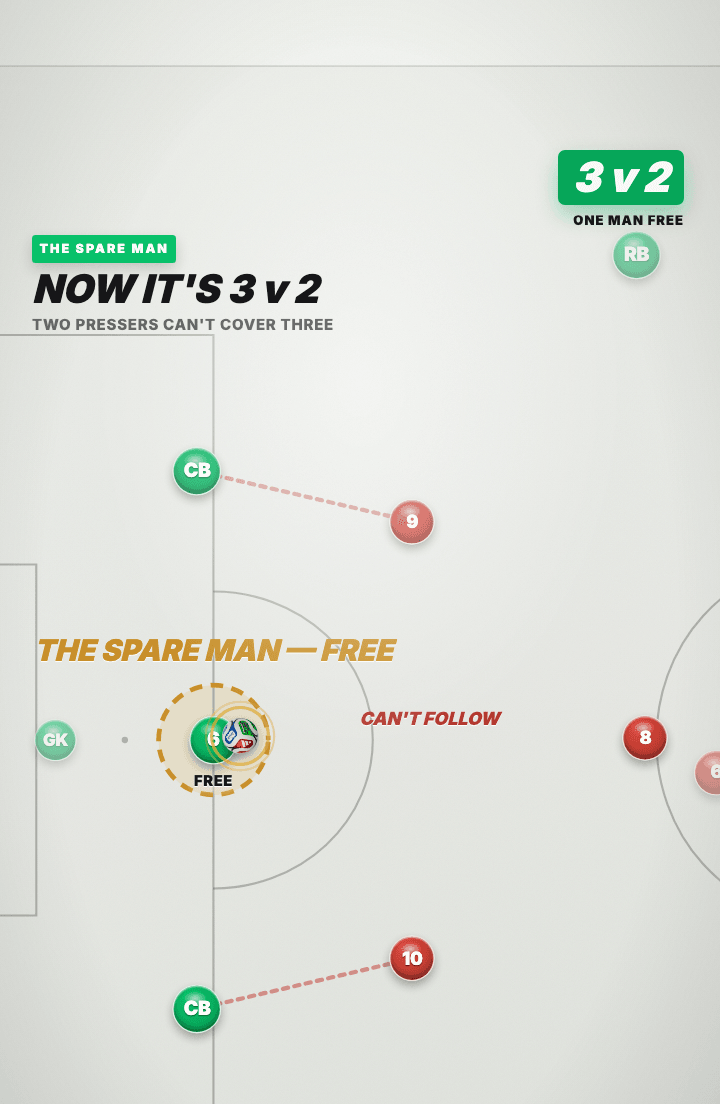
Add a body and the press stops working.
Solution one: drop the six
The salida lavolpiana takes the holding midfielder and drops him between the two centre-backs, making a back three. Two pressers cannot cover three players. One of the three is therefore always free, and because the two forwards have committed forward to press, the middle they left is exactly where he steps through.
The important part is that the free man is created rather than found. Nothing about it depends on the pressers making a mistake. They can do their job perfectly and there is still a spare player, because there are three of them and two of you.
Solution two: use the goalkeeper
Against a man-to-man press the same sum appears in a harder form: they have a presser for every one of your players, so dropping a midfielder just drags his marker down with him. The fix is to field one more passer than they have pressers. The centre-backs split, the goalkeeper steps into the line, and it is three against two again.
Then you invite one in. Under man-to-man marking every presser who comes to the ball leaves the player he was responsible for, so pressure is not something that happens to you, it is something you spend. The team that refuses to use its goalkeeper here is choosing to be a man short in a system that is decided by counting.
On the board Playing Out From The Back Splitting the centre-backs, and the invitation 6 phases →And what the pressing team does about it
If build-up is arithmetic, then pressing well means refusing to be outnumbered by the sum. The answer is not more pressers. It is to stop pressing everywhere and press one place: shut the middle, leave a single door open out to the touchline, and go when the ball travels through it. Four players collapse on the receiver and the sideline does the rest of the marking.
A trap turns the numbers back around, because the whole team arrives at one player at once instead of two forwards arriving at three. It also explains why the extra man works even against very good pressing teams: they are not trying to beat your build-up everywhere. They are waiting for one pass.
On the board The Pressing Trap The door you leave open on purpose 6 phases →- Count before you coach. Two against two is a coin flip whatever the technique.
- Drop the six against a two-man press, step the goalkeeper in against man-to-man.
- The free man is produced by the structure, not discovered. If it depends on an opponent’s error, it is not a build-up plan.
Drawn from
Every claim above is on one of these boards.
Nothing in this post teaches something the diagrams do not show. That is a rule, not a coincidence: the article is written from the systems, never the other way round.
The notebook
One system, explained, every week.
The diagram, the principle, and the detail most people miss. Unsubscribe in one click.
Read next
Narrow is not compact
Two words used as if they mean the same thing. One of them is a strength you build. The other is a weakness you can punish.
One presses, three solve
Watch a back four for one phase and you see four defenders. Watch it for six and you see four jobs being handed down a line.
Four triggers and two clocks
A press is a reaction, not a decision. What the ball has to do first, and how to know whether you can get there.