Four triggers and two clocks
A press is a reaction, not a decision. What the ball has to do first, and how to know whether you can get there.
Nobody presses for ninety minutes. Everybody knows it, and most teams still press as though the alternative were laziness, which is how you end up with players sprinting at a centre-back who has time to look up and play over the top of everyone who just left.
The useful reframing is that a press is not something you decide to do. It is something the ball invites, and it only issues that invitation four ways.
The four triggers
- The ball goes backwards. It is travelling away from your goal and the receiver is facing the wrong way at the moment it arrives.
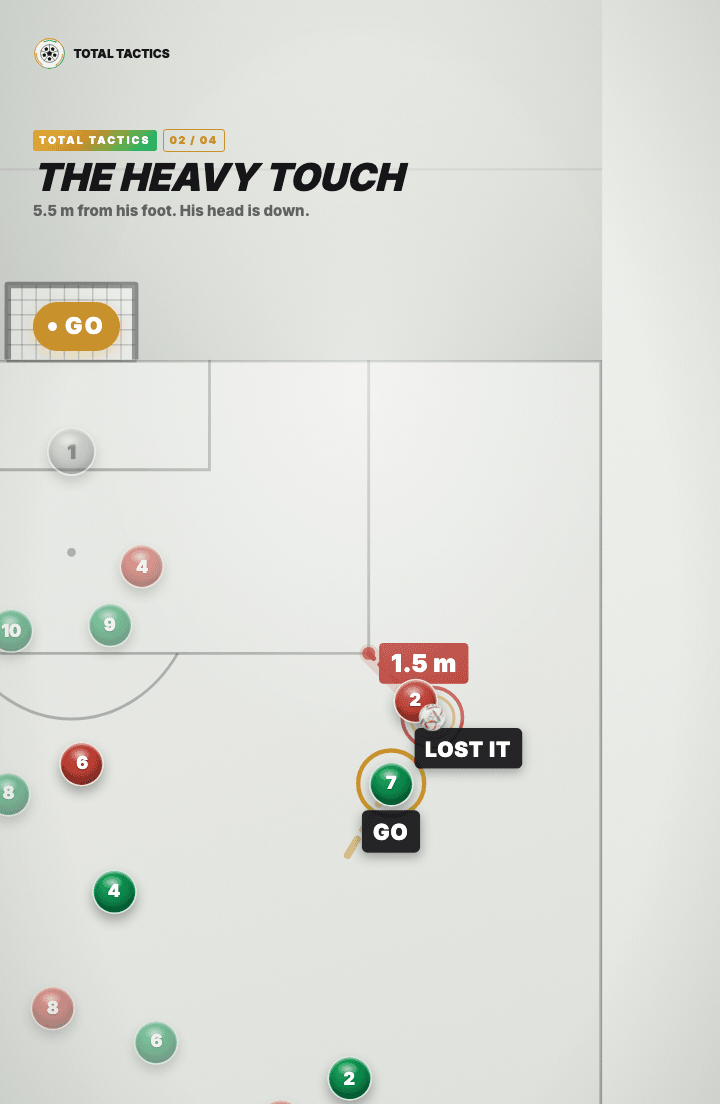
- The ball gets away from someone’s foot. A heavy touch is time, and it is time the receiver did not plan on spending.
- The receiver has his back turned. He cannot see what is behind him, and turning is the only way to find out.
- The ball is in the air. Nobody can play a pass while it is up there, so the clock runs for free.
Each of those buys you a second in which the player on the ball cannot punish you for arriving. That second is the whole product. If none of them has happened, the run is not a press, it is running.
Then compare two clocks
A trigger tells you a press is available. It does not tell you it is yours. That is a comparison of two clocks: how long the man on the ball needs to be safe, against how long you need to reach him. If your clock is shorter, go. If it is not, going is a gift.
If nothing triggered it, you are just running.
It is a comparison a player can actually make at speed, which is more than can be said for most pressing instructions. Distance and body shape are both visible from where he is standing.
Or stop waiting and manufacture one
The four triggers are things that happen to you. A trap is the same idea run forwards: shut the middle, leave exactly one pass available out to the touchline, and make it the pass you want played. When the ball goes through that door the whole team launches at once, four players collapse on the receiver, and the sideline marks for you.
The bait is the part people leave out. A trap with no open pass is just a compact block, and a compact block is a fine thing to be, but it is waiting rather than hunting.
On the board The Pressing Trap Bait, door, and the four who arrive 6 phases →Where the block fits
This is also the honest answer to "press or sit". A mid-block is not the opposite of pressing. It makes the middle of the pitch unavailable and the outside of it inviting, holds about fourteen metres between its banks, and waits. Then the pass down the touchline travels, and the block stops waiting.
The block is the setup, the trigger is the cue, and the press is the last two seconds of a plan that started long before anybody ran. Teams that look like they press constantly are usually just very good at arranging the moments.
On the board The 4-4-2 Mid-Block Inviting the pass you are ready for 6 phases →Drawn from
Every claim above is on one of these boards.
Nothing in this post teaches something the diagrams do not show. That is a rule, not a coincidence: the article is written from the systems, never the other way round.
The notebook
One system, explained, every week.
The diagram, the principle, and the detail most people miss. Unsubscribe in one click.
Read next
Narrow is not compact
Two words used as if they mean the same thing. One of them is a strength you build. The other is a weakness you can punish.
The extra man
Build-up is arithmetic before it is technique. Two ways to make three against two, and what the pressing team does about it.
One presses, three solve
Watch a back four for one phase and you see four defenders. Watch it for six and you see four jobs being handed down a line.