Narrow is not compact
Two words used as if they mean the same thing. One of them is a strength you build. The other is a weakness you can punish.
Listen to enough analysis and the two words arrive together, as if one implies the other: the block was compact and narrow, they stayed narrow and compact. They are not the same measurement. They are not even measured in the same direction, and the difference decides whether a shape is a fortress or a target.
Compact is vertical. It is the distance between your lines, and specifically the gap a pass can be received in. Narrow is horizontal. It is how much of the pitch’s sixty-eight metres your players actually stand on. A team can be one without the other, and the interesting cases are exactly the ones where it is.
Compactness is a number you hold
The 4-4-2 mid-block is the cleanest illustration of the vertical version, because in that system compactness is not a feeling, it is roughly fourteen metres between the two banks of four, held while the whole unit slides. Nothing is supposed to be receivable in between. That is the entire mechanism: not the position of the block on the pitch, but the size of the gap inside it.
On the board The 4-4-2 Mid-Block The gap between the banks, phase by phase 6 phases →Which is why depth and compactness get confused too. Sitting deeper does not make you compact; it just moves the same gap closer to your own goal. Spain against France is the version of this worth copying, because holding the banks close enough that nothing receives between them is the second of the three things that stopped a team built entirely on running into space.
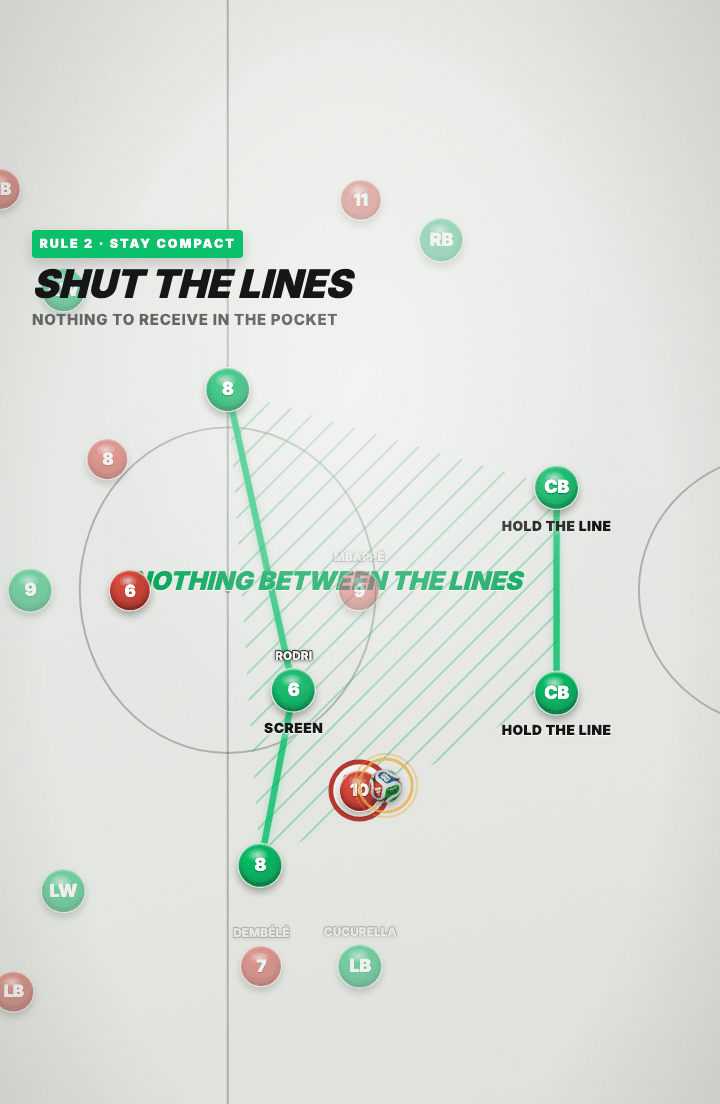
Compact means the gap between your banks, not how deep you sit.
Narrowness is a decision, and it can be forced
Now the horizontal one, where it stops being a virtue. A midfield diamond has no wide midfielders at all, so its four players stand inside about twenty-two of the pitch’s sixty-eight metres. That is narrow. It is not compact in any sense that helps, because the compression is in the direction the ball does not have to travel.
And it gets worse if you help it. Put two players in the pockets either side of the diamond and it follows you in, down to something like fourteen metres of occupied width. You have made an already narrow shape narrower, on purpose, and now the switch to the far touchline is worth playing: the diamond has to travel the whole width itself, and grass moves faster than legs.
On the board How To Beat A Diamond Narrow it first, then switch it 6 phases →Why it matters if you are the one defending
Because the instruction "get compact" is heard by most players as "come inside", and coming inside is the horizontal move. A team that hears it that way ends up occupying less width with the same vertical holes it started with: narrower, no more compact, and now with two touchlines nobody is responsible for.
- Compact is a vertical distance between your own lines. You hold it by moving together, not by dropping.
- Narrow is horizontal occupation. Against a shape that is already narrow, making it narrower is the attack.
- A block that is narrow and not compact has a hole in the middle of it and no width. That is the worst of both.
Two words, two directions. Ask which one somebody means the next time they use both in the same sentence, and quite often the answer is that they have not decided.
Drawn from
Every claim above is on one of these boards.
Nothing in this post teaches something the diagrams do not show. That is a rule, not a coincidence: the article is written from the systems, never the other way round.
The notebook
One system, explained, every week.
The diagram, the principle, and the detail most people miss. Unsubscribe in one click.
Read next
The extra man
Build-up is arithmetic before it is technique. Two ways to make three against two, and what the pressing team does about it.
One presses, three solve
Watch a back four for one phase and you see four defenders. Watch it for six and you see four jobs being handed down a line.
Four triggers and two clocks
A press is a reaction, not a decision. What the ball has to do first, and how to know whether you can get there.