One presses, three solve
Watch a back four for one phase and you see four defenders. Watch it for six and you see four jobs being handed down a line.
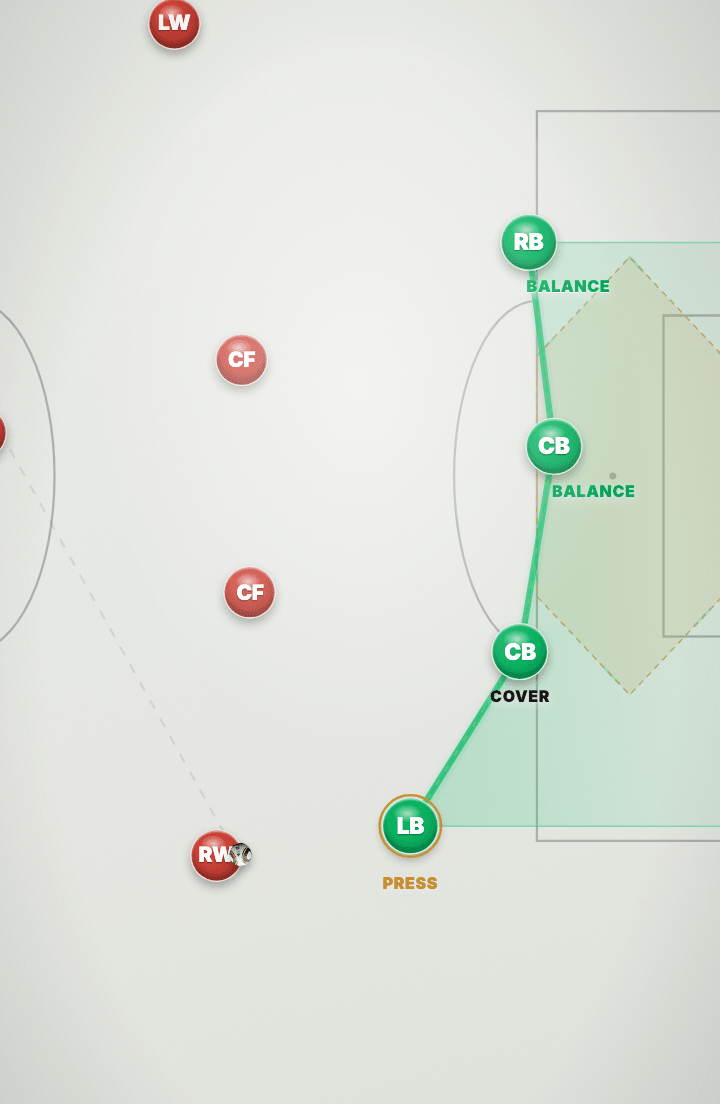
The most common way to watch a defensive line is to watch the ball, which means watching whichever defender is nearest to it. Do that and a back four looks like four individuals taking turns. Watch the other three instead and something more organised appears: at any moment exactly one of them is pressing, and the rest are not watching him. They are solving what happens after the pass.
The jobs, and how many of each
There is one press. There is cover behind the presser, always, and two neighbours covering when the presser is in the middle of the line rather than at its end. Whoever is furthest from the ball tucks in to balance the shape, which is the least visible job and the one that decides whether a switch of play hurts.
The count is the tell. A line where two players go to the ball has stopped being a line, because the cover the presser was promised has left to press as well. A line where nobody goes has invited the ball to be carried into it.
Exactly one defender presses the ball. The other three are solving what happens after the pass.
The jobs walk, the players do not
Then the ball moves across the pitch, and the jobs move with it: the same four players, one role each, a different role than they had a moment ago. The man who was pressing becomes the cover, the cover becomes the balance, and the far side steps in. Nobody swaps positions. The responsibilities walk one seat up the line.
This is why a back four can be taught as a unit and not as four jobs learned separately. There is one system with four seats in it, and every defender will sit in all of them within a phase or two.
What a backward pass is worth
The line also has to get up the pitch, and it cannot do it while it is being asked to mark. So it uses the moments when it is not: while the ball is travelling backwards to the opposition’s holding midfielder, nobody has to be marked at all. That half second is free time, and it is spent squaring up and stepping about two and a half metres higher.
Do it four times and the same four defenders are eight metres further up, with less grass behind them and a smaller hole every time one of them jumps out to press. It is the least athletic way to win territory available: the line does not sprint, it collects.
On the board The Back Four Reset Two and a half metres, four times 6 phases →What it is worth against pace
The obvious objection is a fast forward and the space behind a high line. The answer Spain used against France is that a counter-attack needs a turnover to exist, so the first defence against pace is possession: never hand one over. The second is compactness, so nothing can be received between the lines. The third is doubling up on the winger every single time, so nobody ever gets a one-against-one.
Sprung once, their fastest player runs into a crowd. That crowd is the same four jobs, being done in the same order, by four players who never had to be told which one was theirs.
On the board How Spain Caged France Two players on the winger, every time 6 phases →Drawn from
Every claim above is on one of these boards.
Nothing in this post teaches something the diagrams do not show. That is a rule, not a coincidence: the article is written from the systems, never the other way round.
The notebook
One system, explained, every week.
The diagram, the principle, and the detail most people miss. Unsubscribe in one click.
Read next
Narrow is not compact
Two words used as if they mean the same thing. One of them is a strength you build. The other is a weakness you can punish.
The extra man
Build-up is arithmetic before it is technique. Two ways to make three against two, and what the pressing team does about it.
Four triggers and two clocks
A press is a reaction, not a decision. What the ball has to do first, and how to know whether you can get there.