Attacking · 6 phases
The Underlap
An underlap is a full-back running inside his winger rather than around him, into the space between the opposition full-back and centre-back. It works because it forces a decision on one defender who has two jobs: their holding midfielder must either stay with his man or step out to the ball. He cannot do both, and whichever he drops is the player you use.
- Phases
- 6
- Original
- 22s
- Plays
- 39,381
- Updated
- Aug 2026
Swipe to change phase
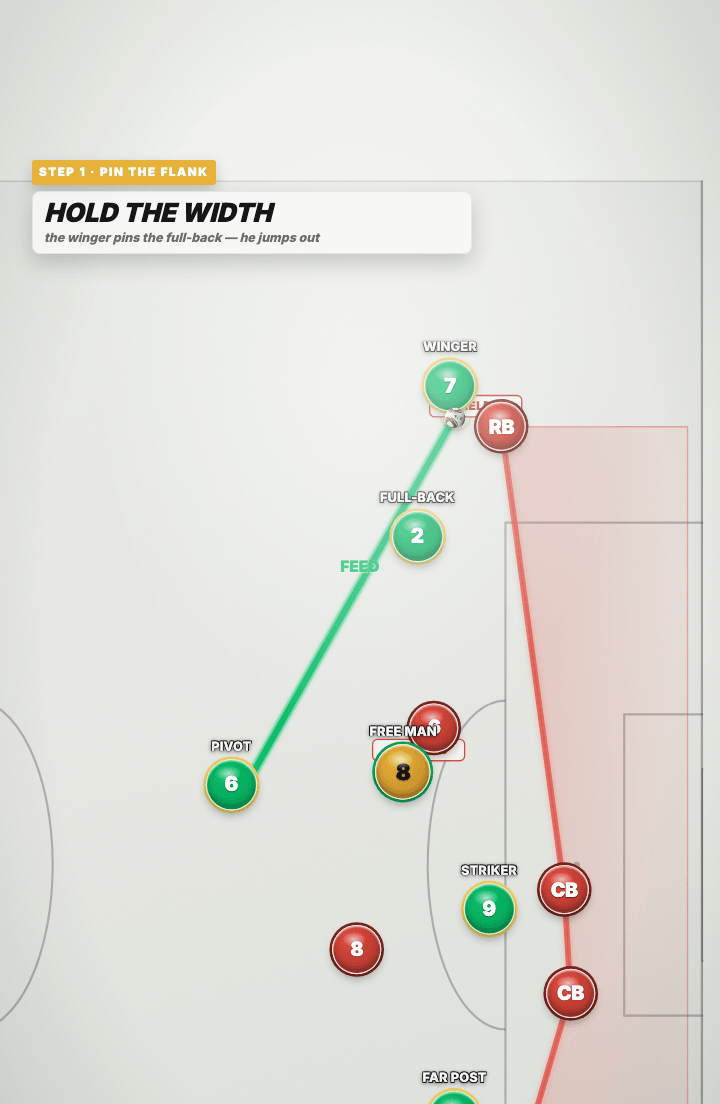
Phase 01 · The ball goes to the winger, who stays high and wide.
Hold the width
The move starts with the winger doing something deliberately unhelpful-looking: standing still, right on the touchline, as far from the goal as he can be. Width is not a way of attacking here, it is a way of stretching. As long as he stays out there, the opposition full-back has to stay out there with him, and the gap between that full-back and his nearest centre-back is being held open by nothing more than the winger’s refusal to come inside. The whole pattern depends on this first, static beat, which is why it is the one most often skipped.
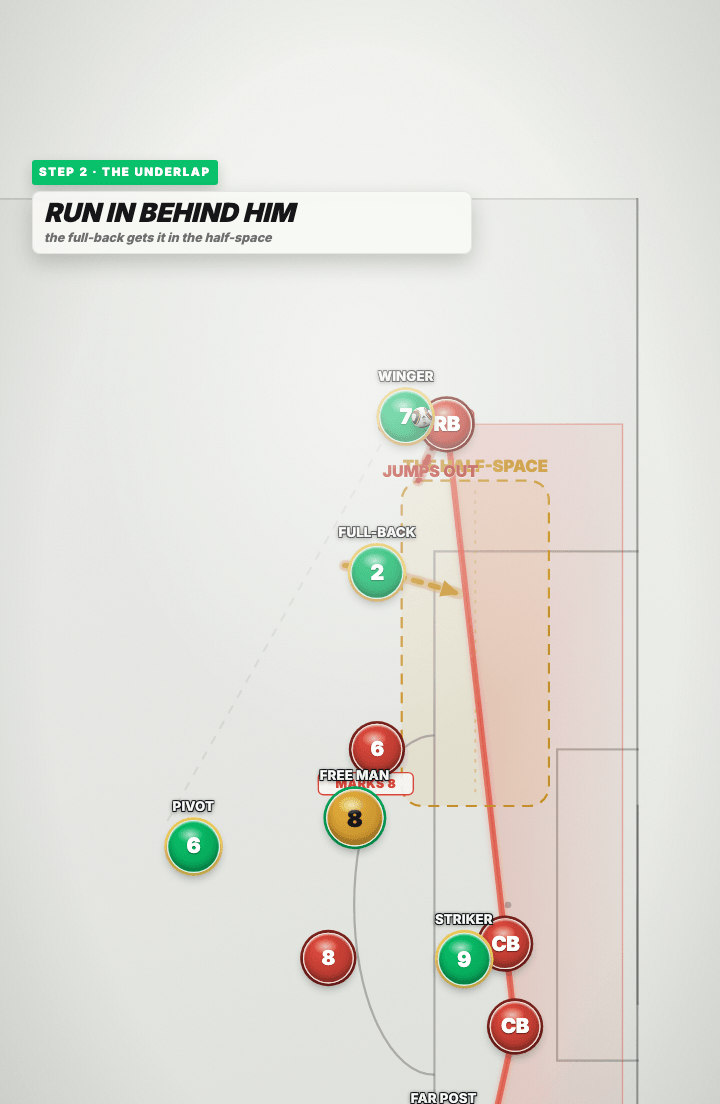
Phase 02 · The full-back jumps out to the ball, and the space appears behind him.
Pin the flank
The winger receives, and the opposition full-back has no choice but to jump out and engage him. He cannot let a winger turn and run at the back four. But the moment he steps forward, the gap he was guarding, the half-space between him and his centre-back, is no longer guarded by anybody, and the board marks him as pinned. Nothing clever has happened yet. One player was made to move by another player standing still, and the space that opened was not created by skill but by the geometry of a defender being in two places at once.
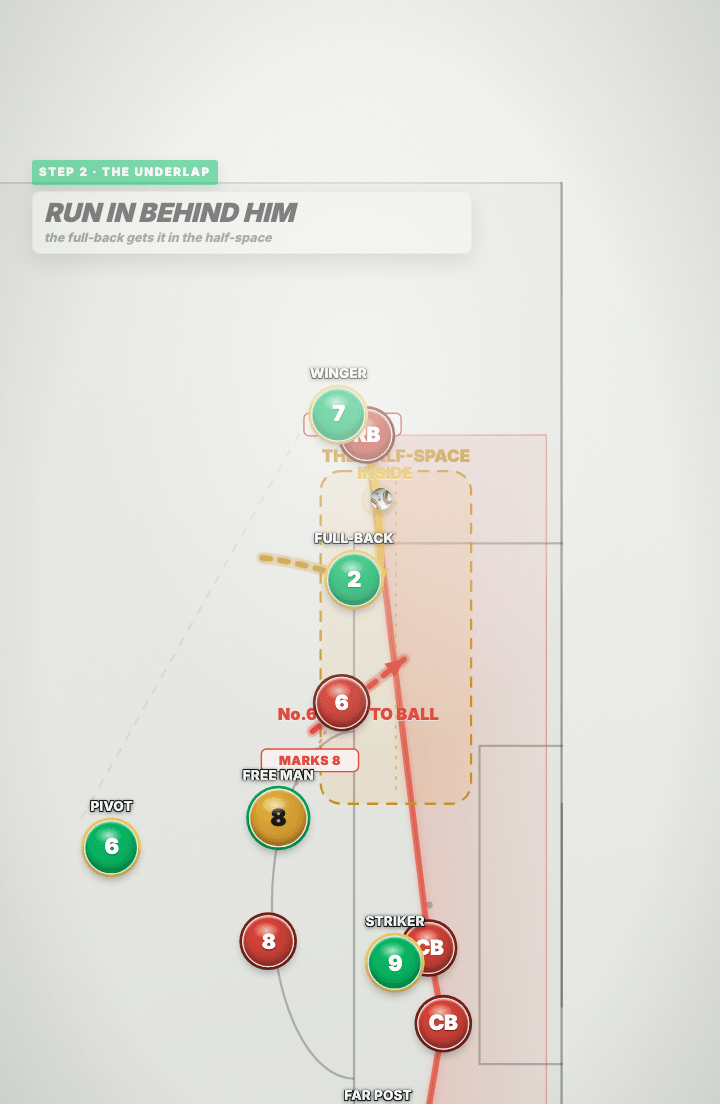
Phase 03 · The full-back runs inside his winger, into the gap behind.
The underlap
Now the run. The green full-back arrives from deep and goes inside his own winger rather than around the outside of him, straight into the space the pinned defender has vacated. This is the detail the name is about. An overlap goes outside and ends with a cross from near the byline; an underlap goes inside and ends in a shooting position. The winger slips the ball into that channel with the simplest pass available, because the run has already done all the work: nobody is tracking it, since the only player whose job it was is currently facing the other way.
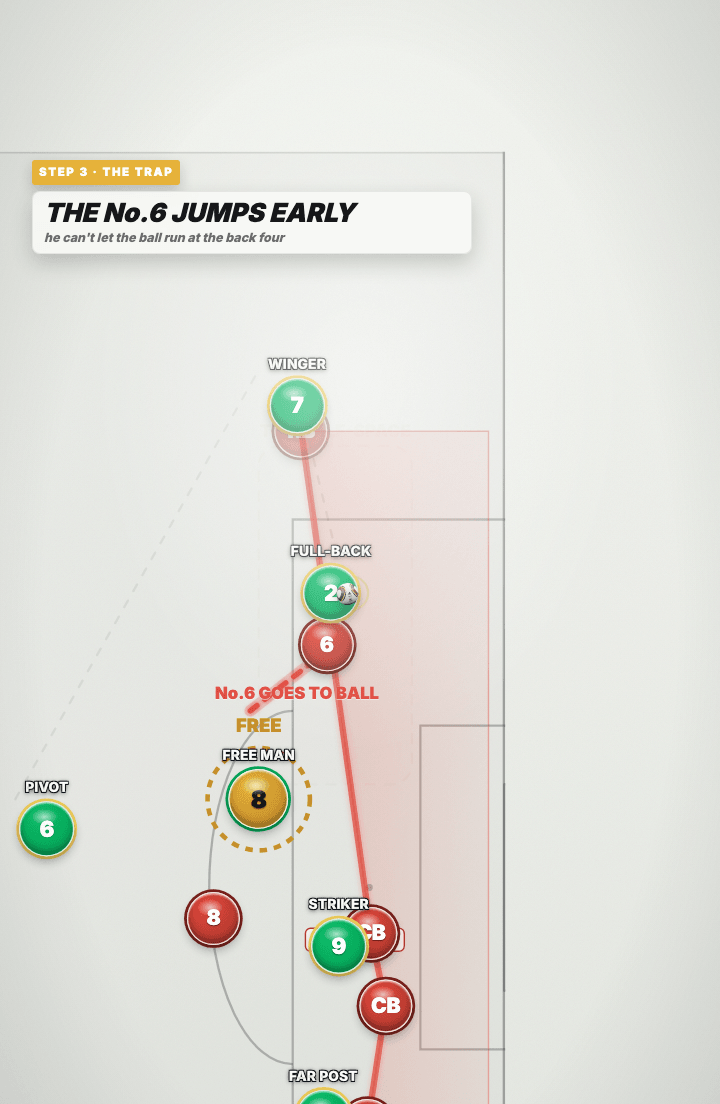
Phase 04 · Received in the half-space, and now their six has a problem.
Make him choose
The ball is collected in the half-space, level with the edge of the box, facing goal. This is where the pattern stops being about running and starts being about a decision. Their holding midfielder is currently doing a job: marking the green number eight in the middle. He is also now the only player who can get to the ball. He can do exactly one of those things. The board draws both at once, and it is worth pausing on: the attacking team has not beaten anyone yet. It has simply arranged the pitch so that one opponent has been given two tasks and one body.
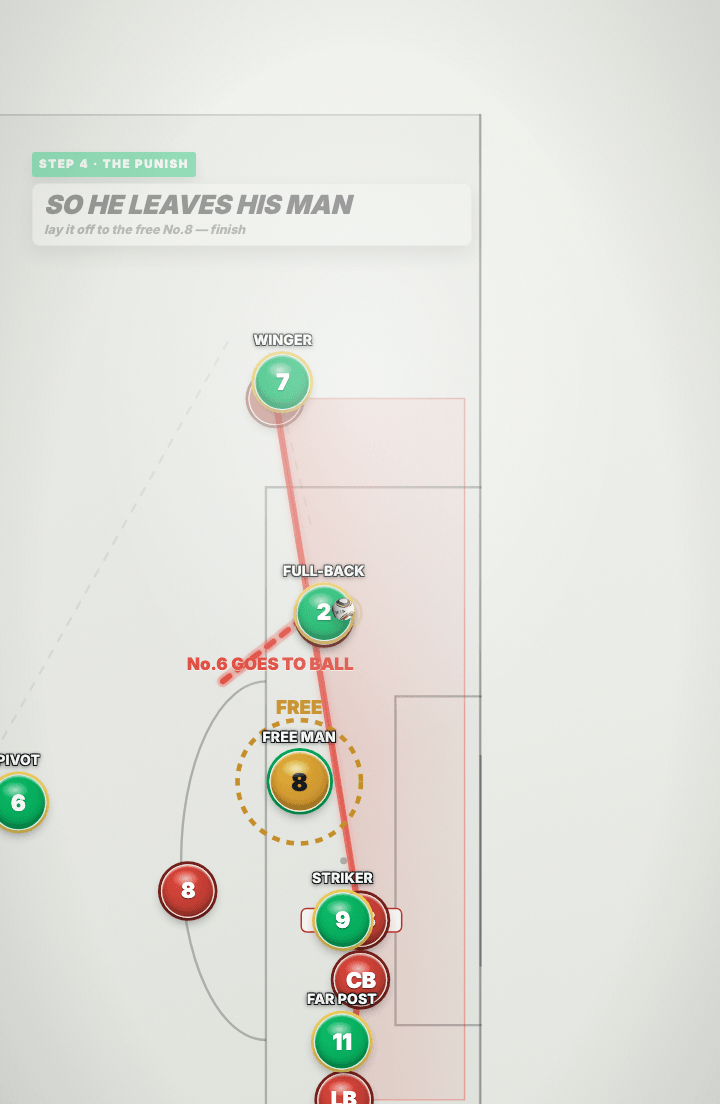
Phase 05 · The six steps out to the ball, and the eight is free.
He leaves his man
He steps out, because he has to: a player on the ball in a shooting position at the edge of the box is the more urgent of his two problems. The instant he does, the man he was marking is free, ringed in gold on the board, standing in the middle of the penalty area with nobody near him. The lay-off is a two-metre pass. Everything that made this goal possible happened before it: a winger who stood still, a full-back who ran the right side of him, and a defender who was asked a question with no good answer. The finish is the least interesting part.
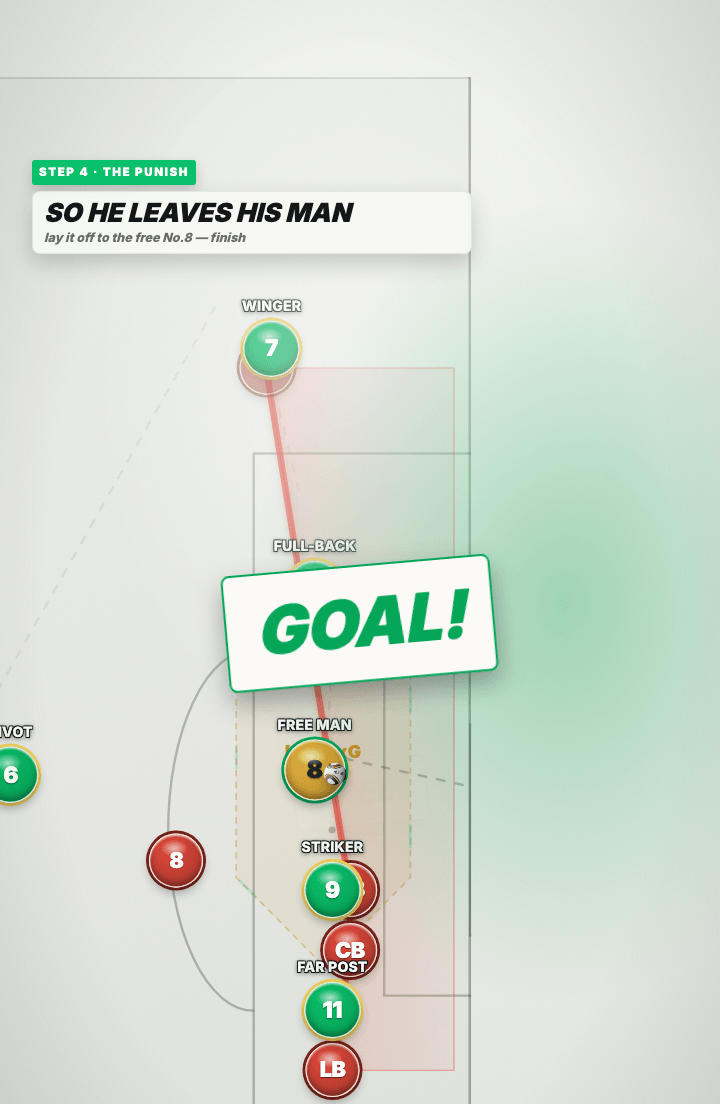
Phase 06 · Laid off to the free man, first time, finished.
The punish
The ball is squared and the free man finishes first time. Look back at what actually beat the defence: no dribble, no one-two, no moment of individual brilliance, just four movements, each one forcing a specific defender to make a specific choice, and a finish from the player nobody was left to watch. That is why the underlap survives against organised teams while a lot of prettier patterns do not. It does not ask a defender to be beaten. It asks him to be in two places, which no defender has ever managed.
The principles
- 01
Run inside your winger, not around him. Outside leads to a cross; inside leads to a shot.
- 02
The run is not trying to beat anyone. It is trying to make one defender do two jobs.
- 03
Whichever job he drops is your goal. Watch the man he abandons, not the man on the ball.
What is the difference between an underlap and an overlap?
The path the full-back takes. An overlap goes around the outside of the winger and usually ends in a cross from a wide angle. An underlap goes inside him, into the space between the opposition full-back and centre-back, and ends in a shot or a cutback.
Why does an underlap work?
It is not trying to beat anybody. It hands one defender, usually their holding midfielder, two jobs at the same moment: stay with the man he is marking, or step out to the ball. He cannot do both, and whichever he lets go is the player who finishes the move.
What does the winger do while the full-back underlaps?
Nothing, and that is the job. He holds the width and stays high, which pins the opposition full-back outside and is what opens the gap inside him in the first place. If the winger drifts in too, there is no space left to run into.
Next
Get the next one.
One system a week, drawn and explained the same way.