Set pieces · 6 phases
The Set-Piece Masterclass
Not by putting it in the mixer. Every routine that works does the same thing: it moves one specific defender out of one specific piece of grass, then puts the ball there. A near-post flick drags the zone forward, a legal screen takes the marker away from the target, a short corner pulls a man out to change the angle, and a worked free-kick uses a dummy to delay the wall’s reaction.
- Phases
- 6
- Original
- 47s
- Updated
- Aug 2026
Swipe to change phase
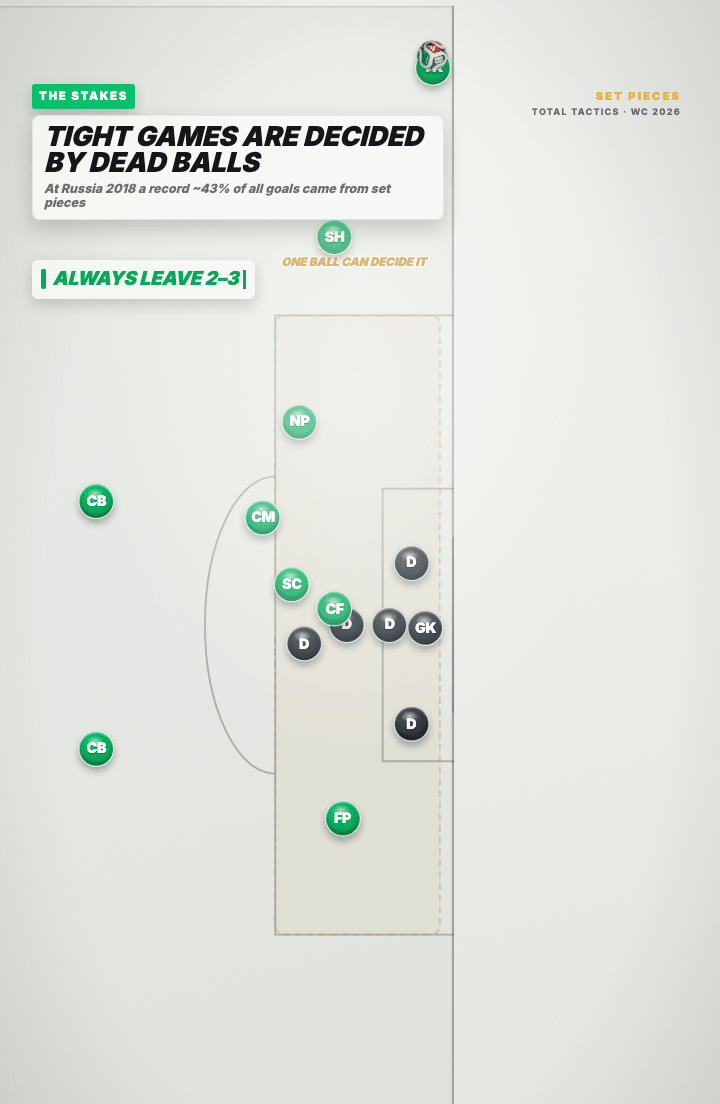
Phase 01 · The set-up, and the reason it is worth this much preparation.
Tight games are decided by dead balls
Knockout football is low-event football. Two well-organised teams cancel each other out for ninety minutes and the margin comes from the one situation where the ball is stationary, the positions are chosen rather than reacted to, and the whole thing can be rehearsed. The board opens with the figure it is built on: at the 2018 World Cup a record share of goals, around forty-three per cent, came from set pieces. That is why every serious side now employs someone whose entire job is dead balls. Note the two centre-backs left outside the box on the left of the picture, marked as the ones staying home: the first rule of attacking a corner is always leaving two or three back, because a counter-attack from a defensive corner is the cheapest goal in the game.
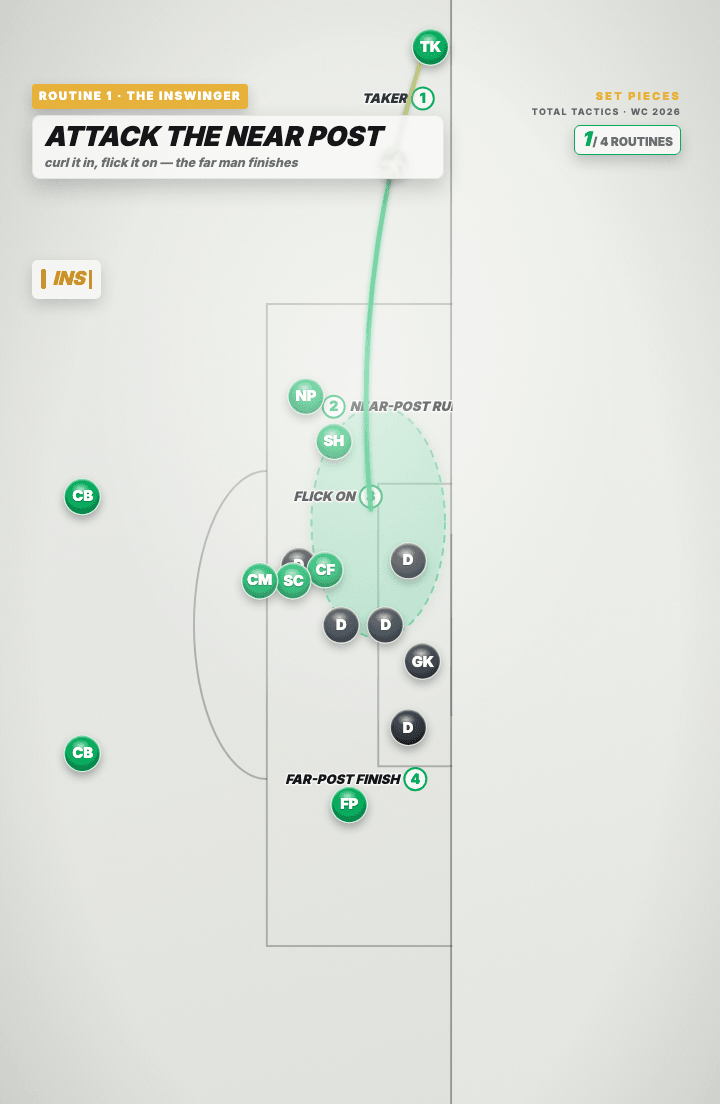
Phase 02 · Attack the near post, flick it on, and let the far man finish.
Routine one: the inswinger
The first routine is drawn as four numbered steps. One, the taker delivers an inswinger. Two, a runner attacks the near post, arriving early and in front of his marker. Three, he does not try to score: he flicks it on, glancing the ball across the six-yard box. Four, the far-post man finishes it. The reason this beats a good goalkeeper is geometry. An inswinging ball is already travelling toward the goal, so a defender who touches it helps it on its way, and a flick at the near post redirects it into the one strip of ground a keeper cannot come for, behind his own body and beyond his own line of vision. The near-post run is the whole routine. The finish is a formality.
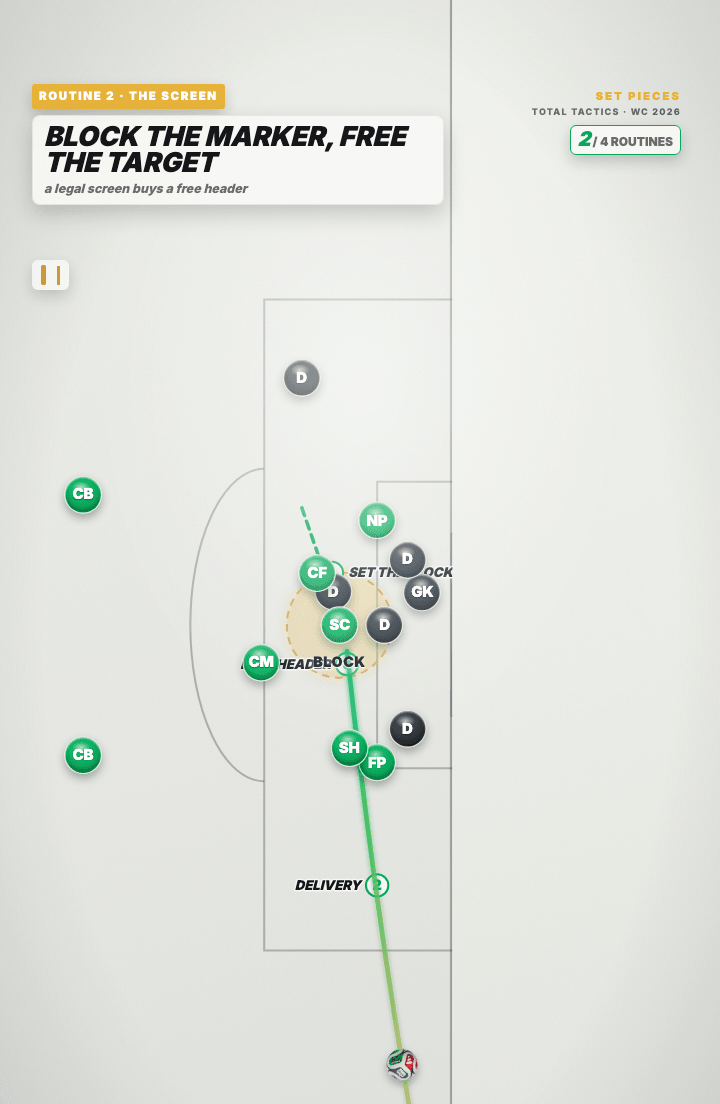
Phase 03 · A legal block takes the marker away, and the target heads it unopposed.
Routine two: the screen
The second routine attacks the marking rather than the space. One green player, marked as the screen, positions himself in the path the defender must run to follow his man, and simply stands there. He is not holding anybody, which is what makes it legal; he is occupying ground first, and the defender has to go around him. In the two-tenths of a second that detour costs, the target has separated and the delivery arrives on a player nobody is close enough to challenge. The board highlights the block itself as the key moment rather than the header, which is the correct emphasis. A free header from eight metres is not a skill. Manufacturing one against a defender who was marking properly is.
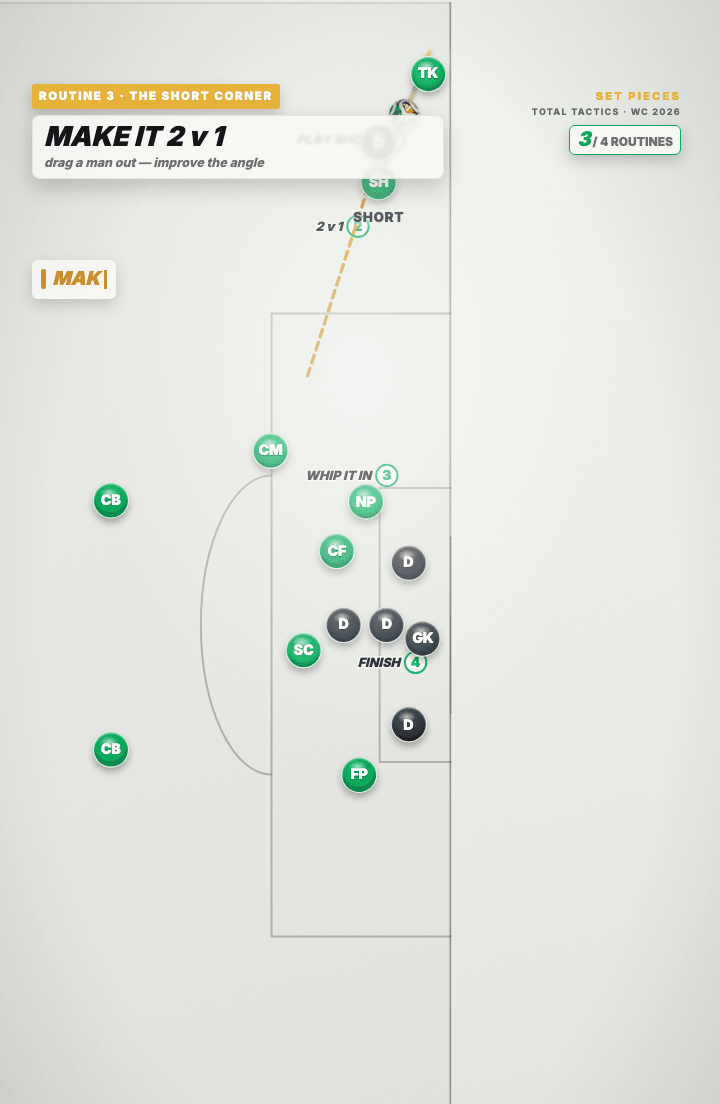
Phase 04 · Two against one at the flag, to drag a defender out and change the angle.
Routine three: the short corner
The third routine does not put the ball into the box at all, at first. A second attacker comes short to the corner flag, making it two against one in that corner, and the defending team has to send someone out to deal with it or concede a free crosser. The board labels the outcome plainly: make it two against one. Two things are gained at once. The defending box loses a body, and the delivery, when it does come, arrives from ten metres further infield and along the goal rather than across it, which is a far harder ball to defend and a far easier one to attack. A short corner is not caution. It is a way of improving the cross before you have taken it.
Phase 05 · A dummy, a delay, and a late run to the back post.
Routine four: the worked free-kick
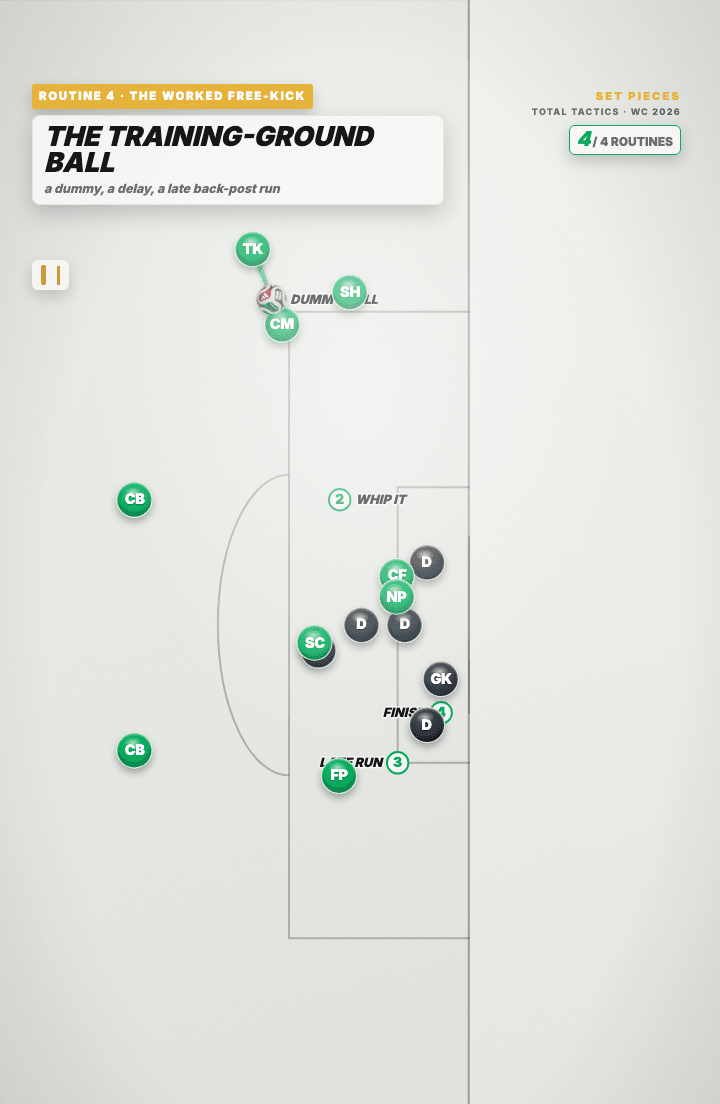
The last routine is the training-ground ball, and it works on the defenders’ eyes rather than their positions. One player runs over the ball and leaves it, which is the dummy, and the wall and the back line both react to a strike that never comes. A second player delays, holding the ball for the extra beat that the reaction costs them, before whipping it in. Meanwhile a runner who was standing still through all of it goes late to the back post. Every part of this is about timing rather than technique: the delivery is ordinary, the run is ordinary, and the goal comes from the half second in which eleven defenders were watching the wrong player.
Phase 06 · The one moment in football that can be rehearsed, in the games that need it most.
Why this decides tournaments
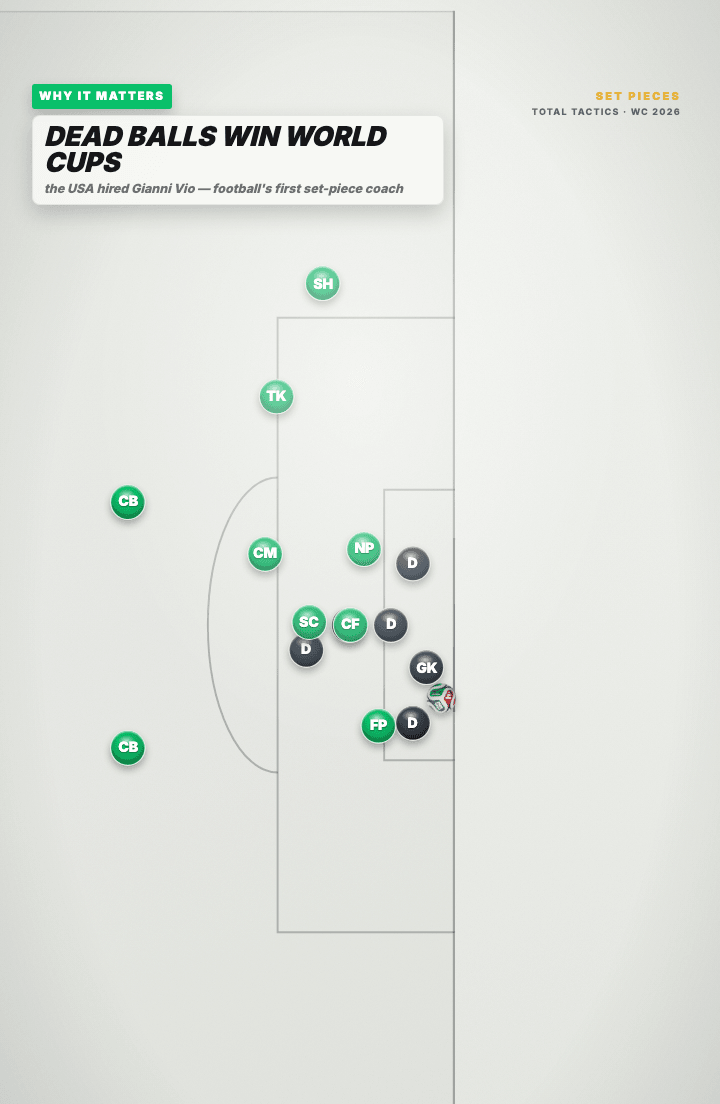
Everything else in football is a reaction to something an opponent did. A dead ball is the only moment where a team gets to choose all eleven positions in advance, against a defence that must also stand still, in a situation it can practise a hundred times. That is why the dedicated set-piece coach has gone from an oddity to a fixture on serious staffs, and why it matters most in tournament football, where preparation time is short, opponents are unfamiliar and knockout games are tight by definition. Open play rewards the better team over ninety minutes. Set pieces reward the better-prepared one over four seconds, and a tournament is decided in four-second increments.
The principles
- 01
A routine is not a delivery. It is a way of removing one defender from one specific patch of grass.
- 02
Attack the near post. A ball flicked on travels away from the goalkeeper and toward the far post.
- 03
Always leave two or three back. The counter off a defensive corner is the fastest goal in football.
Why do some corner routines work when most do not?
Because a routine is not a delivery. Every one that works removes one specific defender from one specific patch of grass and then puts the ball on that grass. Putting it in the mixer removes nobody, which is why it is not a routine at all.
Why attack the near post from a corner?
A ball flicked on at the near post travels away from the goalkeeper rather than towards him, into the ground he has just committed to leaving. Attacking the near post also drags the zonal line forward, which opens the space behind it for the far-post runner.
What is the point of a short corner?
It makes it two against one at the flag, so the defending team has to send a body out or concede a free crosser. Either way the cross improves before it has been taken: one fewer defender in the box, and a delivery from ten metres further infield that runs along the goal rather than across it.
How many players should stay back at an attacking corner?
Two or three, always. The counter-attack off a defensive corner is the fastest goal in football, because every body worth having is at the wrong end of the pitch when it starts.
Next
Get the next one.
One system a week, drawn and explained the same way.